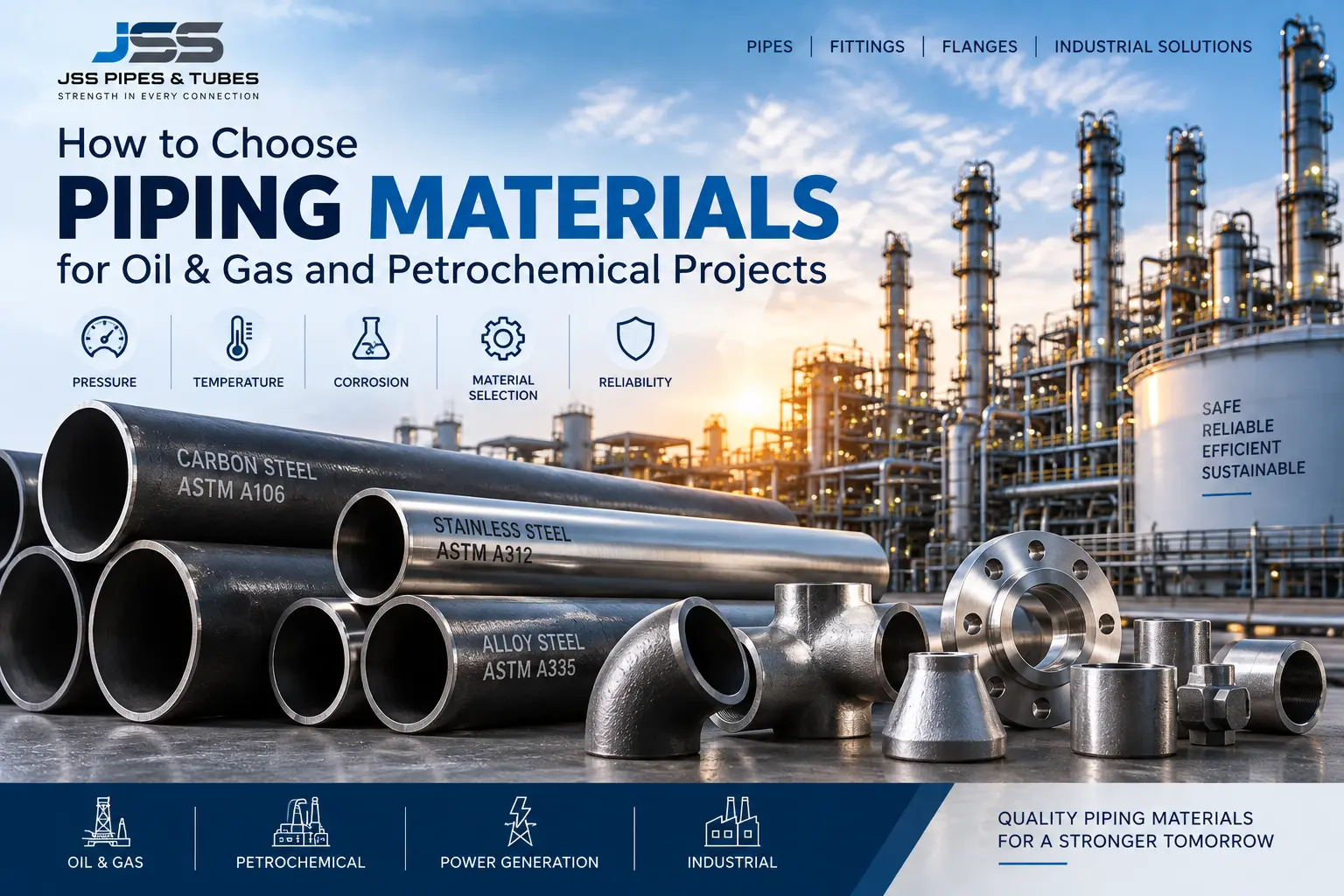
Choosing the right piping materials for oil and gas projects is one of the most important decisions in the design and procurement of an industrial piping system. The selected material must withstand the required pressure, temperature, fluid composition, corrosion conditions and mechanical stresses throughout its intended service life.
Oil and gas and petrochemical facilities use different types of piping materials depending on the process and operating environment. Carbon steel, stainless steel, alloy steel, duplex stainless steel and other specialized materials may all be suitable for specific applications.
However, there is no single material that is best for every project.
The correct choice depends on the actual service conditions, applicable codes and standards, project specifications, material availability and long-term performance requirements.
Key Factors for Selecting Piping Materials
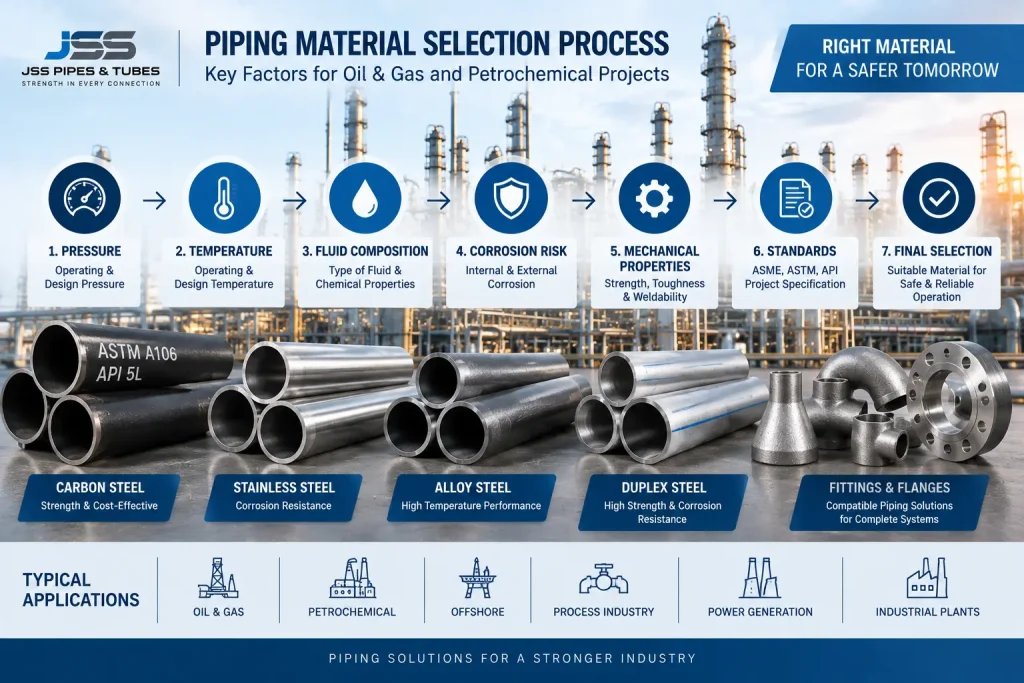
Piping systems in oil and gas and petrochemical facilities can transport crude oil, natural gas, refined hydrocarbons, chemicals, steam, water and other process fluids.
These services can expose piping components to:
- High operating pressure
- High or low temperatures
- Corrosive chemicals
- Moisture and chlorides
- Hydrogen sulfide and other aggressive environments
- Erosion
- Thermal expansion and contraction
- Mechanical stresses
- Continuous operating cycles
Selecting an unsuitable material can increase the risk of corrosion, premature failure, leakage, maintenance problems and unplanned shutdowns.
For this reason, material selection should be considered during the engineering and procurement stages rather than simply choosing a pipe based on price or availability. This is particularly important for oil and gas EPC projects, where engineering, procurement, inspection and material requirements must remain aligned throughout the project lifecycle.
How Are Forged Fittings Manufactured?
Several factors should be evaluated before selecting a piping material for an oil and gas or petrochemical project.
1. Operating Pressure
Pressure is one of the first factors engineers consider when selecting piping materials.
Higher-pressure systems may require materials and pipe wall thicknesses capable of safely containing the operating and design pressure.
Material selection can also affect the required:
- Pipe wall thickness
- Schedule
- Fitting pressure class
- Flange rating
- Valve rating
- Design temperature and pressure limits
However, material grade alone does not determine the pressure capability of a piping system. The complete piping specification, dimensions, design conditions and applicable standards must be considered together.
Engineers should also evaluate the pipe pressure rating alongside material grade, wall thickness, temperature and applicable design requirements when specifying pressure-containing piping.
2. Operating Temperature
Temperature can significantly affect material performance.
Oil and gas and petrochemical piping systems may operate at temperatures ranging from relatively low temperatures to elevated process temperatures.
When selecting a material, engineers should consider:
- Design temperature
- Operating temperature
- Low-temperature toughness
- High-temperature strength
- Thermal expansion
- Heat treatment requirements
- Material compatibility
A material that performs well under normal conditions may not be appropriate when the operating temperature changes significantly.
3. Fluid Composition
The fluid flowing through the piping system is another critical consideration.
Different process fluids can have very different effects on piping materials.
Examples include:
- Crude oil
- Natural gas
- Refined petroleum products
- Hydrocarbons
- Process water
- Steam
- Chemical solutions
- Sour gas
- Gas containing carbon dioxide
The chemical composition, concentration, moisture content and operating conditions of the fluid should be evaluated before finalizing the material.
4. Corrosion and Erosion Risk
Corrosion is a major consideration when selecting petrochemical piping materials.
Depending on the service, piping can be exposed to:
- Internal corrosion
- External corrosion
- Carbon dioxide corrosion
- Hydrogen sulfide environments
- Chloride exposure
- Chemical attack
- Erosion-corrosion
Carbon steel may be highly suitable for many applications, but additional corrosion protection or a different material may be required for more aggressive services.
Stainless steel, duplex stainless steel and other corrosion-resistant alloys may be considered when the service conditions justify their use.
5. Mechanical Properties
The mechanical properties of the material should match the demands of the application.
Important properties can include:
- Yield strength
- Tensile strength
- Hardness
- Toughness
- Ductility
- Weldability
The required properties depend on the design conditions and applicable material specification.
For critical projects, procurement teams should also ensure that the supplied material documentation confirms compliance with the specified grade and requirements.
6. Pipe Size and Wall Thickness
Pipe dimensions also play an important role in material selection and system design.
Engineers may need to evaluate:
- Nominal Pipe Size (NPS)
- Outside diameter
- Wall thickness
- Pipe schedule
- Length
- Connection type
The selected pipe must also be compatible with the fittings, flanges, valves and other components used in the system.
For dimensional reference, engineers can use a suitable pipe size chart when reviewing NPS, outside diameter and related dimensions.
Common Piping Materials Used in Oil & Gas and Petrochemical Projects
Different materials are used depending on the service requirements.
Material | Key Advantages | Typical Applications |
Carbon Steel | Strong, economical and widely available | General oil, gas, water and process services |
Stainless Steel | Good corrosion resistance | Process and corrosive services |
Alloy Steel | Suitable for demanding temperature conditions | High-temperature process services |
Duplex Stainless Steel | High strength and corrosion resistance | Offshore and corrosive environments |
Super Duplex | Excellent corrosion resistance and strength | Severe offshore and specialized services |
The table provides a general overview. Actual material selection should always be based on the project’s engineering requirements.
Carbon Steel for Oil & Gas Piping
When Is Carbon Steel Suitable for Oil & Gas Piping?
Carbon steel pipes are widely used across oil and gas and industrial piping applications because they offer a combination of strength, availability and cost-effectiveness.
Common specifications used for particular applications can include ASTM A106, ASTM A53 and API 5L, depending on the service and project requirements.
Carbon steel may be considered for:
- Oil transportation
- Gas services
- Water lines
- Process piping
- Utility systems
- General industrial applications
- Pipeline applications where the applicable specification permits it
One of its major advantages is availability in a wide range of sizes, wall thicknesses and grades.
However, corrosion resistance must be carefully evaluated when carbon steel is considered for aggressive services.
Stainless Steel for Petrochemical Applications
When Should Stainless Steel Be Used?
Stainless steel may be selected when corrosion resistance is a major requirement.
Common stainless steel grades used in industrial applications include:
- 304
- 304L
- 316
- 316L
The appropriate grade depends on the actual process conditions.
Stainless steel may be considered for:
- Corrosive process fluids
- Chemical processing
- Chloride-containing environments
- Specialized process systems
- Applications where improved corrosion resistance is required
Although stainless steel can have a higher initial material cost than carbon steel, its corrosion resistance may provide advantages in applications where maintenance and service life are important considerations.
Alloy Steel and Duplex Materials
When Are Alloy Steel and Duplex Materials Considered?
Some oil and gas and petrochemical services require materials with properties beyond those normally provided by standard carbon steel.
Alloy Steel
Alloy steel may be considered for applications where elevated-temperature performance, strength or other specific material properties are required.
Duplex Stainless Steel
Duplex stainless steel combines relatively high mechanical strength with strong corrosion resistance and can be considered for demanding applications.
It may be used in areas such as:
- Offshore facilities
- Chemical processing
- Corrosive services
- High-demand process systems
Super Duplex Stainless Steel
Super duplex materials may be considered for particularly demanding corrosive environments where a combination of strength and corrosion resistance is required.
The material should always be selected according to the actual service conditions rather than simply choosing the most corrosion-resistant option available.
Are Piping Materials Different for Oil & Gas and Petrochemical Projects?
Not necessarily.
Both oil and gas and petrochemical facilities can use materials such as:
- Carbon steel
- Stainless steel
- Alloy steel
- Duplex stainless steel
The difference comes from the specific service conditions.
For example, one process line may be suitable for carbon steel, while another line in the same facility may require stainless steel or a specialized alloy because of its temperature, pressure or chemical composition.
Therefore, material selection should be based on the individual piping service rather than the industry name alone. Understanding these differences is important when evaluating petrochemical piping requirements, particularly for process lines exposed to demanding pressure, temperature or corrosive conditions.
Step-by-Step Piping Material Selection Process
1. Define the Process Fluid
Start by identifying exactly what the piping system will transport.
Review the fluid’s:
- Chemical composition
- Concentration
- Moisture content
- Corrosive properties
- Contaminants
- Operating conditions
2. Establish Design Pressure
Determine the required design pressure and operating pressure.
This information helps engineers evaluate the required pipe specification, wall thickness, fittings and other pressure-containing components.
3. Establish Design Temperature
Identify both operating and design temperatures.
Consider:
- Maximum temperature
- Minimum temperature
- Temperature fluctuations
- Thermal cycling
- Potential heat exposure
4. Assess Corrosion and Erosion
Evaluate the likelihood of:
- Internal corrosion
- External corrosion
- Pitting
- Chemical attack
- CO₂-related corrosion
- Sour-service conditions
- Erosion
This step can significantly influence the choice between carbon steel, stainless steel and more specialized materials.
5. Select the Preliminary Material
Based on the service conditions, engineers can identify suitable material options.
For example:
General service → Carbon steel may be considered
Corrosive service → Stainless steel may be considered
High-temperature service → Alloy steel may be considered
Demanding corrosive service → Duplex or specialized alloys may be considered
These are general examples rather than universal rules.
6. Verify Applicable Codes and Standards
The selected material must comply with the applicable project requirements and standards.
Depending on the component and application, specifications may reference:
- ASME
- ASTM
- API
- NACE/AMPP requirements where applicable
- Project-specific specifications
Understanding the difference between ASME and ASTM standards can help procurement teams identify the requirements applicable to materials, dimensions, design and other aspects of industrial piping.
The relevant standard should be verified for the particular pipe, fitting, flange or other component.
7. Confirm Pipe, Fitting and Flange Compatibility
Material selection does not stop with the pipe.
The complete piping system may include:
- Pipes
- Elbows
- Tees
- Reducers
- Couplings
- Forged fittings
- Flanges
- Valves
- Gaskets
- Bolting
These components need to be compatible with the service conditions, material requirements and pressure-temperature ratings of the system.
8. Review Testing and Inspection Requirements
For many industrial projects, documentation and inspection are important parts of procurement.
Depending on the project specification, requirements may include:
- Chemical analysis
- Mechanical testing
- Hydrostatic testing
- Dimensional inspection
- Non-destructive testing
- Heat treatment
- Material Test Certificates
- Traceability documentation
9. Check Availability and Lead Time
Engineering suitability is not the only procurement consideration.
EPC teams should also review:
- Stock availability
- Manufacturing lead time
- Required quantity
- Material grade availability
- Size availability
- Delivery schedule
- Documentation requirements
For large projects, early procurement planning can help reduce delays.
10. Finalize the Piping Material Specification
The final selection should be documented within the project’s piping material specification.
This helps ensure consistency between:
Engineering → Procurement → Supplier → Inspection → Fabrication → Installation
Why Pipe, Fittings and Flanges Must Be Compatible
A piping system is made up of multiple connected components.
Selecting the correct pipe while overlooking the fittings or flanges can create compatibility problems.
For example, procurement teams should verify:
- Material grade
- Nominal size
- Wall thickness
- Pressure class
- Connection type
- Dimensional standard
- Temperature rating
- Corrosion requirements
This is particularly important for oil and gas and petrochemical projects where multiple suppliers may provide different components.
Cost vs Performance: What Should You Prioritize?
Should Cost Be the Main Factor in Piping Material Selection?
No.
Initial purchase price is important, but it should not be the only consideration.
A lower-cost material can potentially result in higher lifecycle costs if it requires:
- More corrosion protection
- Frequent maintenance
- Earlier replacement
- Additional inspection
- More downtime
A more expensive material may be justified when it provides the required performance and service life.
Therefore, EPC procurement teams should evaluate:
Initial Cost → Installation → Maintenance → Corrosion → Replacement → Downtime → Lifecycle Cost
The objective should be to select the most suitable material for the service, not simply the cheapest material.
Common Piping Material Selection Mistakes
1. Choosing Material Based Only on Price
Cost should be evaluated alongside performance and service requirements.
2. Ignoring Fluid Chemistry
The fluid composition can have a major effect on corrosion and material compatibility.
3. Ignoring Temperature
Material performance can change significantly at elevated or low temperatures.
4. Ignoring Corrosion Risk
A material suitable for general service may not be appropriate for an aggressive environment.
5. Selecting Pipe Without Checking Fittings and Flanges
All connected components need to meet the system requirements.
6. Using the Wrong Material Grade
Similar-looking materials can have significantly different specifications and performance characteristics.
7. Ignoring Applicable Standards
The correct material must comply with the applicable project and industry requirements.
8. Not Checking Material Documentation
For industrial procurement, MTCs and traceability can be important for verifying supplied material.
9. Buying Based Only on Nominal Pipe Size
NPS alone does not provide all the dimensional information required for procurement.
10. Not Reviewing the Project Specification
Client and EPC specifications may contain requirements beyond basic material standards.
What Should EPC Procurement Teams Check Before Ordering Piping Materials?
Before placing an order, procurement teams should review the complete requirement.
Piping Material Procurement Checklist
- Material grade
- Pipe type
- Seamless or welded requirement
- Nominal pipe size
- Schedule/wall thickness
- Length
- Applicable ASTM/API/ASME specification
- Design pressure
- Design temperature
- Corrosion requirements
- Testing requirements
- Inspection requirements
- MTC requirements
- Heat number/traceability
- Coating or surface treatment where applicable
- Required quantity
- Delivery schedule
- Project-specific documentation
This checklist can help reduce procurement errors and improve coordination between engineering and purchasing teams.
Carbon Steel vs Stainless Steel for Oil & Gas Piping
One of the most common material-selection questions is whether carbon steel or stainless steel should be used.
Factor | Carbon Steel | Stainless Steel |
Initial Cost | Generally lower | Generally higher |
Strength | High for many applications | Varies by grade |
Corrosion Resistance | Lower without protection | Generally higher |
Availability | Widely available | Widely available in common grades |
General Process Services | Commonly used | Used where required |
Corrosive Services | May require protection | Often preferred where suitable |
Maintenance | Depends on corrosion environment | Can offer advantages in corrosive service |
The correct choice depends on the actual process conditions.
How to Ensure Proper Piping Material Procurement
Working with an experienced industrial piping supplier can help procurement teams source materials according to project requirements.
For project-specific requirements, an experienced steel pipe supplier in UAE can help procurement teams source pipes according to the required grade, size, schedule, applicable standards and documentation requirements.
Before purchasing, provide the supplier with as much technical information as possible, including:
- Required material
- Grade
- Size
- Schedule
- Quantity
- Applicable standard
- Testing requirements
- Inspection requirements
- Documentation requirements
- Delivery location and timeline
For large EPC projects, clear specifications reduce the risk of receiving materials that do not match the project requirements.
FAQs About Piping Materials for Oil & Gas and Petrochemical Projects
Q1. What materials are commonly used in oil and gas piping?
Ans – Common materials include carbon steel, stainless steel, alloy steel and duplex stainless steel. The appropriate material depends on pressure, temperature, fluid composition, corrosion conditions and project specifications.
Q2. Which pipe material is best for oil and gas projects?
Ans – There is no single best pipe material for every oil and gas project. Carbon steel is widely used for many general services, while stainless steel, alloy steel or duplex materials may be selected for specific corrosive, high-temperature or demanding applications.
Q3. Is carbon steel suitable for oil and gas piping?
Ans – Yes. Carbon steel is widely used in oil and gas piping for many applications because of its strength, availability and cost-effectiveness. Its suitability depends on the specific service conditions and applicable project specification.
Q4. When should stainless steel be used in petrochemical piping?
Ans – Stainless steel may be considered when improved corrosion resistance is required. The appropriate grade should be selected based on the fluid chemistry, temperature, chloride exposure and other service conditions.
Q5. What factors affect piping material selection?
Ans – Important factors include operating pressure, temperature, fluid composition, corrosion, erosion, mechanical properties, pipe size, applicable standards, compatibility, inspection requirements, availability and project specifications.
Q6. How does temperature affect pipe material selection?
Ans – Temperature can affect material strength, toughness, thermal expansion and long-term performance. Both maximum and minimum design temperatures should be considered when selecting piping materials.
Q7. How does pressure affect piping material selection?
Ans – Pressure influences the required material properties, pipe wall thickness, schedule, fittings and flange ratings. The complete piping design must be evaluated rather than selecting material based on pressure alone.
Q8. How does corrosion affect piping material selection?
Ans – Corrosion risk can influence whether carbon steel, stainless steel, duplex stainless steel or another material is appropriate. Fluid chemistry, moisture, chlorides, CO₂, H₂S and operating conditions should be evaluated.
Q9. What standards are used for oil and gas piping materials?
Ans – Depending on the application, piping projects may reference ASME, ASTM, API and applicable corrosion-related requirements such as NACE/AMPP. The exact standard depends on the component and project specification.
Q10. Are piping materials for oil and gas and petrochemical projects the same?
Ans – Many of the same materials can be used in both industries, including carbon steel, stainless steel and alloy materials. However, the final selection depends on the specific service conditions and project requirements.
Q11. What should EPC companies check before purchasing piping materials?
Ans – EPC companies should verify material grade, pipe type, size, schedule, applicable standards, quantity, testing and inspection requirements, documentation, traceability and delivery requirements before placing an order.
Q12. How do you ensure pipe, fittings and flanges are compatible?
Ans – Compatibility should be checked by reviewing material grade, size, pressure class, temperature requirements, connection type, applicable dimensional standards and project specifications for all connected components.
Conclusion
Choosing the right piping materials for oil and gas and petrochemical projects requires a detailed evaluation of service conditions rather than simply comparing material prices.
Pressure, temperature, fluid composition, corrosion risk, mechanical properties, applicable standards, component compatibility and project specifications all play an important role in the final selection.
Carbon steel can be an economical and widely used option for many general services, while stainless steel, alloy steel and duplex materials may be considered when specific corrosion, temperature or performance requirements exist.
For EPC and industrial procurement teams, the best approach is to define the service conditions clearly, verify the applicable specifications and ensure that pipes, fittings, flanges and related components are sourced according to the same project requirements.
For projects requiring reliable sourcing of industrial piping materials, working with an experienced piping materials supplier in UAE can help procurement teams identify and source pipes and related components according to project specifications, required standards and delivery requirements.