
Petrochemical Piping Suppliers in UAE
Petrochemical projects require piping materials that can perform reliably under demanding operating conditions, including high pressure, elevated temperatures, corrosive environments, and continuous industrial service. Selecting the right pipes, fittings, flanges, and related components is therefore an important part of project procurement.
JSS Pipes supplies piping materials for petrochemical projects in the UAE, supporting contractors, EPC companies, procurement teams, and industrial projects with a range of piping products based on project specifications and applicable standards.
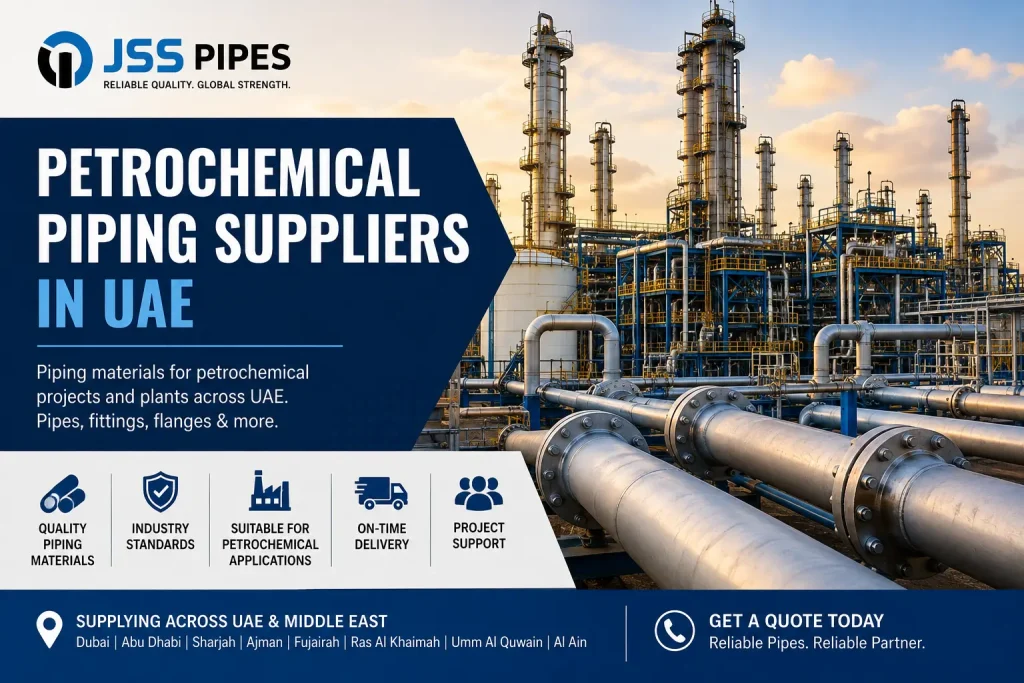
Petrochemical Piping Materials for UAE Projects
Petrochemical facilities use extensive piping networks to transport hydrocarbons, chemicals, gases, steam, water, and other process fluids between equipment and process units. Each piping system requires materials selected according to its operating conditions and engineering specifications.
Commonly required piping materials include:
- Carbon steel pipes
- Stainless steel pipes
- Seamless pipes
- Welded pipes
- Pipe fittings
- Forged fittings
- Industrial flanges
- Weldolets and branch connections
- Other piping components required for project applications
JSS Pipes can support procurement requirements based on the required material grade, size, schedule, pressure class, quantity, and applicable standard.
Piping Products for Petrochemical Applications
A petrochemical project may require multiple piping components rather than pipes alone. Coordinating these materials according to the project material list can help simplify procurement and ensure that the required specifications are followed.
For petrochemical projects requiring reliable piping systems, JSS Pipes works as a trusted steel pipe supplier in UAE, providing seamless, welded, carbon steel and stainless steel pipes for demanding industrial applications.
Pipes
Pipes form the main transportation routes within petrochemical facilities. Depending on the application, projects may specify carbon steel, stainless steel, seamless, or welded pipes.
The appropriate pipe selection can depend on factors such as:
- Operating pressure
- Operating temperature
- Fluid characteristics
- Corrosion requirements
- Pipe size and wall thickness
- Material grade
- Project specifications
Pipe Fittings
Pipe fittings are used to connect, redirect, branch, or modify piping systems. Common requirements can include elbows, tees, reducers, and other fittings specified according to the project’s piping class.
For petrochemical applications, fitting selection should consider the required dimensions, material, pressure rating, connection type, and applicable standards.
For projects requiring elbows, tees, reducers, caps, and other connection components, JSS Pipes supplies industrial products through its range of pipe fittings suppliers in UAE.
Flanges
Flanges provide detachable connections between piping components, valves, equipment, and other parts of a piping system. Depending on the application, projects may require different flange types, pressure classes, materials, and facing configurations.
JSS Pipes supplies industrial flanges according to project requirements and applicable specifications.
Forged Fittings and Branch Connections
Forged fittings are commonly specified for demanding piping applications where strength and pressure-handling requirements are important. Branch connections such as weldolets may also be required when creating connections between different sections of a piping system.
The required fitting or branch connection should be selected according to the piping specification, size, material grade, pressure requirements, and applicable standard.
For high-pressure applications, you can also explore JSS Pipes’ forged fittings and flanges for project-specific piping requirements.
Pipes for Petrochemical Piping Systems
The pipe material used in a petrochemical facility depends on the service conditions and project engineering requirements.
Carbon steel pipes are commonly considered for many general industrial and process applications where the material provides the required mechanical performance and service compatibility.
Stainless steel pipes may be selected where greater corrosion resistance or specific material compatibility is required.
Seamless pipes are manufactured without a longitudinal welded seam and can be specified for applications where their mechanical and pressure characteristics meet the project requirements.
Welded pipes are manufactured using a welding process and are available in different sizes, wall thicknesses, and specifications for suitable industrial applications.
The final selection should always follow the project’s approved piping specification rather than being based solely on the material name.
Materials and Standards for Petrochemical Piping
Petrochemical projects typically involve detailed technical specifications covering material grades, dimensions, manufacturing requirements, testing, inspection, and applicable standards.
Depending on the product and project, specifications may reference standards such as ASME, ASTM, API, ANSI, or other applicable international standards.
When requesting a quotation, it is useful to provide the relevant project documentation so the required piping materials can be matched to the correct specifications.
Important details can include:
- Product type
- Nominal pipe size
- Schedule or wall thickness
- Material grade
- Pressure class
- Connection type
- Applicable standard
- Required quantity
- Inspection or certification requirements
- Delivery requirements
Supporting Petrochemical Plant and Project Requirements
Petrochemical plants can involve multiple process units and extensive piping systems. Procurement may therefore require different piping materials in varying sizes, grades, and quantities.
JSS Pipes supports requirements for petrochemical projects and industrial piping applications in the UAE, including the supply of pipes, fittings, flanges, forged fittings, and other piping components.
For larger requirements, project material lists, bills of quantities, material requisitions, or technical datasheets can be used to identify the required products and specifications.
This approach can help procurement teams provide accurate requirements when requesting pricing and availability.
These piping materials can also support oil & gas and EPC projects where procurement is based on approved specifications and project requirements.
Why Choose JSS Pipes for Petrochemical Piping Supply?
Choosing the appropriate piping supplier is important when a project involves multiple materials and technical specifications.
JSS Pipes can support petrochemical piping requirements with:
- A range of industrial piping materials
- Pipes, fittings, flanges, and forged components
- Support for project-based procurement requirements
- Materials selected according to specified grades and standards
- Bulk supply requirements
- UAE-focused industrial supply
- Support for oil & gas, petrochemical, EPC, and industrial applications
For project-specific requirements, supplying the material list or technical specification can help ensure the quotation is based on the actual project needs.
Request a Quote for Petrochemical Piping Materials
Looking for petrochemical piping suppliers in the UAE for an upcoming project?
Send JSS Pipes your required material list, specifications, quantities, or project details. The requirement can then be reviewed for the appropriate pipes, fittings, flanges, and other piping materials.
Contact JSS Pipes today to discuss your petrochemical piping material requirements and request a quotation.
FAQs – Frequently Asked Questions
Q1. What piping materials are commonly used in petrochemical projects?
Ans – Commonly specified materials include carbon steel, stainless steel, and other materials selected according to the process conditions, fluid service, pressure, temperature, corrosion requirements, and project specifications.
Q2. What types of pipes are used in petrochemical plants?
Ans – Petrochemical plants can use different types of pipes, including seamless, welded, carbon steel, and stainless steel pipes. The appropriate type depends on the piping specification and operating conditions.
Q3. How do I choose the right piping material for a petrochemical project?
Ans – Material selection should consider pressure, temperature, fluid characteristics, corrosion requirements, mechanical properties, pipe dimensions, applicable standards, and the project’s approved piping specifications.
Q4. Can petrochemical piping materials be supplied according to project specifications?
Ans – Yes. Piping materials can be specified according to the project’s required material grade, dimensions, schedule, pressure class, standards, quantities, and other technical requirements.
Q5. What information is required to request a petrochemical piping quotation?
Ans – Useful information includes the product type, size, schedule or wall thickness, material grade, pressure class where applicable, standard, quantity, delivery location, and project requirements. A material requisition or bill of quantities can make the quotation process more efficient.
Q6. Do you supply pipes and fittings for petrochemical projects in the UAE?
Ans – JSS Pipes supplies industrial piping materials including pipes, fittings, flanges, forged fittings, and other piping components for petrochemical, oil & gas, EPC, and industrial project requirements in the UAE.
Q7. Which standards are commonly specified for petrochemical piping?
Ans – Depending on the product and application, project specifications may reference ASME, ASTM, API, ANSI, and other applicable international standards. The exact standard should be confirmed from the project’s technical documentation.
Q8. Can JSS Pipes support bulk piping material requirements for petrochemical projects?
Ans – Yes. Bulk requirements can be assessed using project material lists, bills of quantities, material requisitions, or technical specifications to identify the required products, quantities, and specifications.