Forged Fittings and Flanges
Forged fittings and flanges are essential components in industrial piping systems where reliable connections, pressure resistance, and long-term performance are critical. They are widely used in oil and gas, petrochemical, refinery, power generation, chemical processing, marine, and EPC projects.
JSS Pipes supplies forged fittings and flanges for industrial applications across the UAE and Middle East, with options available in different materials, connection types, pressure classes, and specifications.
Whether you need socket weld fittings, threaded fittings, weld neck flanges, blind flanges, or other forged piping components, selecting the correct product requires careful consideration of pipe size, material, pressure, temperature, and applicable standards.
Need forged fittings or flanges for your project? Get a Quote from JSS Pipes.
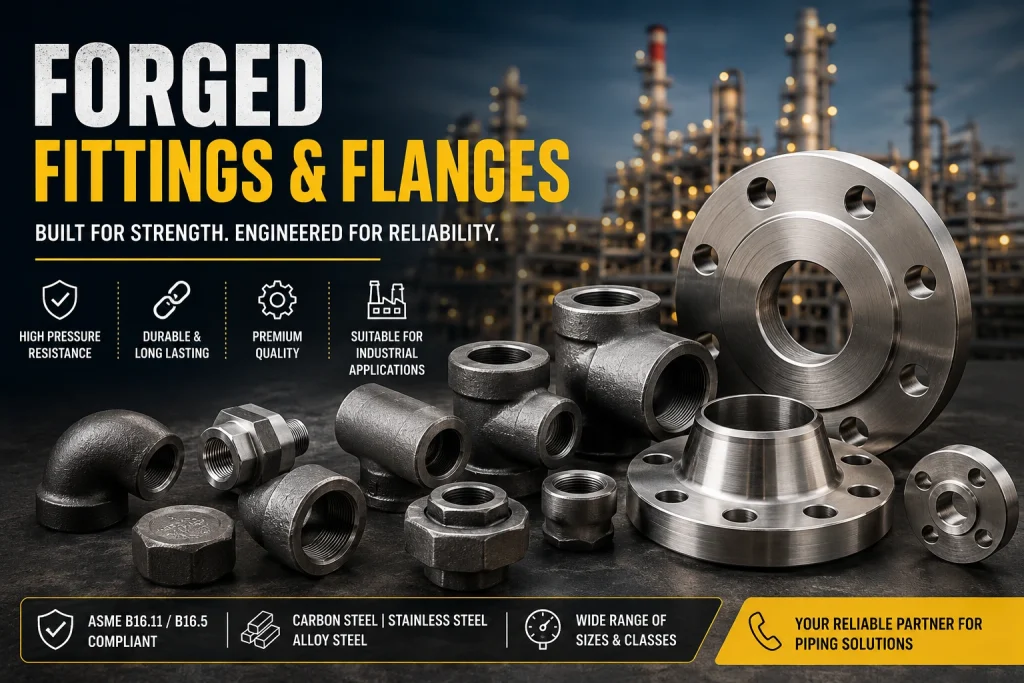
Forged Fittings and Flanges for Industrial Piping
Forged fittings are manufactured from metal that is shaped using controlled forging processes, producing components designed for demanding piping applications. They are commonly used to connect, redirect, branch, or terminate piping systems.
Flanges provide detachable connections between pipes, valves, equipment, and other piping components. They can simplify inspection, maintenance, equipment replacement, and system modifications.
Forged components form an important part of complete piping systems, and reliable Pipe Fittings Suppliers in UAE can help source compatible fittings for different industrial applications.
Together, forged fittings and flanges provide reliable connection solutions for piping systems operating under demanding pressure, temperature, and service conditions.
Common applications include:
- Oil and gas pipelines
- Petrochemical plants
- Refineries
- Chemical processing facilities
- Power plants
- EPC projects
- Marine installations
- Industrial process systems
Our Forged Fittings and Flanges Range
JSS Pipes provides a range of industrial forged fittings and flanges to support different piping configurations and project requirements.
Forged Pipe Fittings
Depending on project requirements and availability, forged fittings can include:
- Forged elbows
- Forged tees
- Forged crosses
- Couplings
- Half couplings
- Unions
- Bushings
- Plugs
- Caps
- Swage nipples
- Branch connection fittings
For specialized branch connections, customers can also explore solutions from experienced Weldolet Suppliers in UAE for oil and gas, petrochemical, and industrial piping applications.
These components are used to connect pipes of different configurations while maintaining the required mechanical and dimensional characteristics of the piping system.
Socket Weld Forged Fittings
Socket weld fittings are designed for applications where the pipe is inserted into a socket within the fitting and welded around the connection.
They are commonly used in smaller-diameter piping systems where a compact and strong connection is required.
Typical applications include:
- High-pressure utility lines
- Process piping
- Instrumentation systems
- Chemical processing
- Oil and gas facilities
Threaded Forged Fittings
Threaded fittings use internal or external threads to connect piping components without requiring a welded joint at the fitting connection.
They can be suitable for selected low- to medium-pressure applications and systems where welding is undesirable or impractical.
The appropriate threaded fitting should always be selected according to the applicable pressure, temperature, material, thread specification, and project requirements.
Industrial Flanges
Flanges are used where piping components need to be connected using bolted joints. They are particularly useful when sections of a piping system may need to be dismantled for inspection, maintenance, or equipment replacement.
Common flange types include:
Weld Neck Flanges
Weld neck flanges have a long tapered hub and are commonly selected for demanding pressure and temperature applications.
They are widely used in:
- Refineries
- Petrochemical plants
- Oil and gas facilities
- Power plants
- Process piping systems
Slip-On Flanges
Slip-on flanges are installed over the pipe and welded in position. They are commonly selected for applications where installation simplicity and cost efficiency are important.
Blind Flanges
Blind flanges are used to close the end of a pipe, nozzle, valve, or other piping connection. They can also facilitate future access or system modification.
Socket Weld Flanges
Socket weld flanges are commonly used with smaller-diameter piping systems where the pipe is inserted into the flange socket before welding.
Threaded Flanges
Threaded flanges provide a connection without requiring welding and can be useful for selected piping applications.
Lap Joint Flanges
Lap joint flanges are used with stub-end assemblies and can be useful where piping systems require frequent dismantling.
Forged Fittings by Connection Type
Choosing the correct connection method is important for ensuring the reliability and maintainability of an industrial piping system.
Socket Weld Connections
Socket weld connections are commonly used for smaller pipe sizes and applications where a compact welded connection is required.
The pipe is inserted into the fitting and welded externally around the connection.
Threaded Connections
Threaded connections use compatible threads to join piping components without welding.
They can be useful in applications where the piping system requires easy assembly or where welding is not preferred.
The thread type and dimensions should always match the project specification and mating component.
Materials Available for Forged Fittings and Flanges
Material selection is one of the most important decisions when specifying forged fittings and flanges.
The material must be suitable for the operating pressure, temperature, fluid, corrosion environment, and applicable project standards.
Carbon Steel
Carbon steel forged fittings and flanges are widely used because of their strength, durability, and cost efficiency.
Typical applications include:
- Oil and gas
- Refineries
- Water systems
- Industrial utilities
- General process piping
Common material specifications may include ASTM A105 for forged carbon steel piping components, subject to the specific product and project requirements.
For projects using carbon steel throughout the piping system, you can also explore our Carbon Steel Pipe Suppliers in UAE solutions for compatible industrial piping requirements.
Stainless Steel
Stainless steel provides improved resistance to corrosion and is suitable for applications where piping components may be exposed to moisture, chemicals, aggressive fluids, or marine environments.
Common stainless steel grades used for industrial piping components can include:
- 304
- 304L
- 316
- 316L
The appropriate grade should be selected according to the operating environment and project specification.
For stainless steel piping applications, our SS Fittings Suppliers in UAE solutions can support projects requiring corrosion-resistant piping components.
Alloy Steel
Alloy steel fittings and flanges can be selected for applications involving elevated temperatures, demanding mechanical requirements, or specific process conditions.
Material selection may include specifications such as ASTM A182 for applicable forged alloy and stainless steel components.
Forged Fittings and Flanges: Standards and Pressure Classes
Industrial piping components must be manufactured and supplied according to the applicable project standards.
Two important ASME standards commonly encountered in this area are ASME B16.11 and ASME B16.5.
ASME B16.11
ASME B16.11 covers forged fittings used with socket-welding and threaded connections. It addresses requirements such as dimensions, ratings, tolerances, marking, and material-related requirements within its scope.
ASME B16.5
ASME B16.5 covers pipe flanges and flanged fittings within its specified size range and addresses areas such as dimensions, pressure-temperature ratings, materials, tolerances, marking, and testing.
Common Pressure Classes
Forged fittings may be specified according to pressure classes such as:
- Class 2000
- Class 3000
- Class 6000
- Class 9000
Flanges commonly use classes such as:
- Class 150
- Class 300
- Class 400
- Class 600
- Class 900
- Class 1500
- Class 2500
Important: The appropriate class should not be selected based only on the class number. Material, temperature, pressure, size, product type, and applicable standard must all be considered.
How to Select the Right Forged Fittings or Flanges
Selecting the right component requires more than simply choosing a fitting based on size. Since fittings and flanges must match the piping system, sourcing them alongside suitable products from a reliable Steel Pipe Supplier UAE can help ensure dimensional and material compatibility.
1. Check the Pipe Size
Determine the nominal pipe size and required connection dimensions before selecting the fitting or flange.
2. Determine Operating Pressure
The component must be suitable for the pressure conditions of the piping system.
3. Consider Operating Temperature
Temperature can affect material performance and allowable pressure ratings, making it an important part of product selection.
4. Select the Correct Material
Choose carbon steel, stainless steel, alloy steel, or another suitable material based on the fluid and operating environment.
5. Confirm the Connection Type
Determine whether the system requires:
- Socket weld
- Threaded
- Butt weld
- Flanged
- Other specified connections
6. Verify the Applicable Standard
Always check the applicable ASME, ASTM, API, project, or client specification before purchasing.
7. Consider Corrosion Conditions
For marine, chemical, offshore, and other corrosive environments, material selection becomes particularly important.
Forged Fittings vs Butt Weld Fittings
Forged fittings and butt weld fittings serve different roles within piping systems.
Feature | Forged Fittings | Butt Weld Fittings |
Common connection | Socket weld or threaded | Butt weld |
Typical application | Smaller-bore piping | Small and large-bore piping |
Installation | Compact connection | Requires welding |
Typical pressure applications | High-pressure applications | Process and industrial piping |
Space requirement | Relatively compact | Requires welding access |
Common standards | ASME B16.11 | ASME B16.9 |
The appropriate fitting depends on the pipe size, pressure, application, welding requirements, and project specification.
Applications of Forged Fittings and Flanges
Forged fittings and flanges are used across a wide range of industries where reliable piping connections are required.
Oil and Gas
Oil and gas facilities use forged fittings and flanges throughout process, utility, gathering, and equipment connection systems.
Components must be selected according to operating pressure, temperature, fluid characteristics, and applicable project specifications.
Petrochemical Projects
Petrochemical facilities handle a wide range of process fluids and operating conditions. Correct material and pressure-class selection is therefore essential.
Refineries
Refineries use piping components throughout process units, utility systems, equipment connections, and maintenance points.
Power Generation
Forged fittings and flanges can be used in steam, water, fuel, cooling, and other utility piping systems.
Chemical Processing
Chemical plants may require corrosion-resistant materials and specialized piping components depending on the fluids being transported.
EPC Projects
EPC contractors require piping components that match detailed engineering specifications, approved materials, dimensions, pressure classes, and applicable standards.
Marine and Industrial Applications
Marine and industrial environments can expose piping systems to moisture, salt, vibration, and demanding operating conditions. Appropriate material and component selection is essential for reliable service.
Why Choose JSS Pipes for Forged Fittings and Flanges?
JSS Pipes provides industrial piping products for customers across the UAE and Middle East.
Our product range supports applications in:
- Oil and gas
- Petrochemical
- EPC
- Refineries
- Power generation
- Marine
- Chemical processing
- Industrial infrastructure
We can support project requirements involving different fitting types, flange configurations, materials, sizes, pressure classes, and applicable standards.
For procurement teams, contractors, engineers, and project managers, providing the correct technical details at the quotation stage helps ensure that the required products can be identified efficiently.
Get a Quote
Looking for forged fittings and flanges in UAE?
Send your required:
- Product type
- Pipe size
- Material grade
- Pressure class
- Connection type
- Applicable standard
- Required quantity
- Project/application details
to JSS Pipes for quotation assistance.
FAQs – Frequently Asked Questions
Q1. What information should I provide when requesting a forged fitting or flange quote?
Ans – For an accurate quotation, provide the required fitting or flange type, pipe size, material grade, pressure class, connection type, applicable standard, quantity, and project requirements. Additional information such as operating pressure, temperature, or fluid service can also help determine the appropriate specification.
Q2. How do I know which forged fitting specification is suitable for my project?
Ans – The correct specification depends on pipe size, connection type, pressure, temperature, material, fluid service, and applicable engineering standards. Project drawings, piping material specifications, and equipment requirements should be reviewed before final selection.
Q3. Can forged fittings and flanges be supplied for EPC projects in the UAE?
Ans – Yes. Forged fittings and flanges are commonly required for EPC projects involving oil and gas, petrochemical, refinery, power, and industrial facilities. Product selection should follow the project’s approved material specifications and applicable standards.
Q4. Can forged fittings be supplied in specific ASTM or ASME grades?
Ans – Yes, forged fittings can be specified according to applicable ASTM and ASME requirements depending on the product, material, size, pressure class, and project specification. The required standard and grade should be confirmed before ordering.
Q5. What details are required to check forged fitting availability?
Ans – The most useful information includes fitting type, nominal size, material grade, pressure class, connection type, standard, quantity, and delivery requirements. Providing a project datasheet or material list can make the quotation process more efficient.
Q6. Are forged fittings suitable for high-pressure piping systems?
Ans – Forged fittings are widely used in high-pressure piping applications when the fitting type, material, pressure class, dimensions, and applicable standard are correctly selected for the operating conditions.
Q7. Can I request a quotation for forged fittings and flanges in bulk quantities?
Ans – Yes. Bulk requirements can be submitted with the required product specifications, quantities, delivery location, and project details so the appropriate products can be assessed for quotation.
Q8. Do you supply forged fittings and flanges for oil and gas projects?
Ans – JSS Pipes supplies industrial piping components for applications including oil and gas, petrochemical, refinery, EPC, power generation, marine, and other industrial projects. Product selection is based on the required project specifications.
Conclusion
Forged fittings and flanges play an important role in industrial piping systems where reliable connections, pressure capability, and long-term performance are required. From socket weld and threaded forged fittings to weld neck, blind, slip-on, and other flange configurations, the correct component depends on the piping system and its operating conditions.
Material, pressure class, connection type, dimensions, temperature, fluid service, and applicable ASME or ASTM requirements should all be evaluated before procurement.
JSS Pipes supplies forged fittings and flanges for industrial and EPC applications across the UAE and Middle East, supporting projects in oil and gas, petrochemical, refinery, power, marine, and other demanding sectors.
Need forged fittings or flanges for your project? Contact JSS Pipes and request a quote.