A106, A53 or API 5L? Start With the Service
Three carbon steel pipe specifications cover most of what moves through UAE plants and pipelines: ASTM A106, ASTM A53 and API 5L. On paper, their Grade B versions look almost identical. In service, they are written for different jobs.
Here is the quick version:
- ASTM A106 is seamless pipe for high-temperature process service.
- ASTM A53 is seamless or welded pipe for general and lower-pressure service.
- API 5L is line pipe for transporting oil, gas and water over distance.
The rest of this guide explains why that matters, how the grades compare, and what to order alongside them.
ASTM A106: Seamless Pipe for High Temperature
A106 covers seamless carbon steel pipe in Grades A, B and C. Grade B is the workhorse of refineries, gas plants and power stations, used for process lines, steam and hot hydrocarbons.
Two details set it apart:
- It is seamless only. There is no welded A106.
- It requires killed steel, with a minimum silicon content of 0.10%. This gives a cleaner, more uniform structure that holds up better at temperature.
Grade C has higher strength (275 MPa minimum yield) for when the designer wants a thinner wall at the same pressure.
ASTM A53: General-Purpose Pipe
A53 is broader. It comes in three types:
- Type S: seamless
- Type E: electric resistance welded (ERW)
- Type F: furnace-butt welded (Grade A only)
It is used for utility lines, cooling water, compressed air, low-pressure steam and structural work. A53 has no silicon minimum, which is one reason A106 is preferred for hot service.
API 5L: Line Pipe for Pipelines
API 5L is written for pipelines, not plant piping. It runs from Grade B up through the “X” grades, where the number is the minimum yield strength in thousands of psi. X52 means 52,000 psi (360 MPa).
API 5L pipe can be seamless, ERW, LSAW or spiral welded (SSAW), and it comes in two product levels:
- PSL1: the standard level.
- PSL2: tighter chemistry and carbon-equivalent limits, a maximum as well as a minimum yield strength, mandatory Charpy impact testing and full traceability. Most oil and gas operators in the region specify PSL2 for hydrocarbon pipelines.
Side-by-Side Comparison
| ASTM A106 Gr B | ASTM A53 Gr B | API 5L Gr B (PSL1) | API 5L X52 (PSL1) | |
| Manufacturing | Seamless only | Seamless or ERW | Seamless or welded | Seamless or welded |
| Main use | High-temperature process piping | General, utility, structural | Pipelines | Higher-pressure pipelines |
| Min. yield strength | 240 MPa (35 ksi) | 240 MPa (35 ksi) | 245 MPa (35.5 ksi) | 360 MPa (52 ksi) |
| Min. tensile strength | 415 MPa (60 ksi) | 415 MPa (60 ksi) | 415 MPa (60 ksi) | 460 MPa (66.7 ksi) |
| Killed steel / Si min. | Yes, 0.10% Si | Not required | Not required | Not required |
| Impact testing | Not mandatory | Not mandatory | Mandatory under PSL2 | Mandatory under PSL2 |
Always check strength values against the current edition of each standard and the project specification.
What “Triple-Certified” Pipe Means
Many stockists hold seamless pipe certified to A106 Gr B, A53 Gr B and API 5L Gr B at the same time, sometimes with X42 added. The mill makes it to the strictest combination of chemistry and testing, so one heat satisfies all three.
For buyers, this means faster supply and simpler stock. Still, check the stencil and the mill test certificate. Triple certification only counts if all three specifications appear on both.
Beyond Carbon Steel: Grades You’ll Meet on UAE Projects
| Grade | What it is | Where it’s used |
| ASTM A333 Gr 6 | Carbon steel impact-tested at −45 °C (−50 °F) | LNG, cold process and flare lines |
| ASTM A312 TP304/304L, TP316/316L | Austenitic stainless steel pipe | Corrosive, chemical and hygienic service |
| ASTM A358 | Electric-fusion-welded stainless pipe | Larger-diameter stainless lines |
| ASTM A335 P11, P22 | Chrome-moly alloy steel | Hot hydrocarbon and steam lines |
| ASTM A335 P91 | 9Cr-1Mo-V alloy steel | High-temperature steam in power plants |
| ASTM A790 (UNS S31803/S32205) | Duplex stainless steel | Seawater, desalination, offshore |
For wet sour service (hydrogen sulphide present), materials must also meet NACE MR0175 / ISO 15156, which limits hardness and sets testing requirements. Mention it on the enquiry; it changes what can be supplied.
Still choosing between carbon and stainless? Our carbon steel vs stainless steel pipe comparison covers cost, corrosion and service life.
Match the Fittings and Flanges to the Pipe
A pipe grade never travels alone. The elbows, tees and flanges must be the matching material group, or the weld procedure and the design both fail.
| Pipe | Buttweld fittings | Forged flanges & fittings |
| A106 Gr B / A53 Gr B | ASTM A234 WPB | ASTM A105 |
| A333 Gr 6 | ASTM A420 WPL6 | ASTM A350 LF2 |
| A312 TP316L | ASTM A403 WP316L | ASTM A182 F316L |
| A335 P11 | ASTM A234 WP11 | ASTM A182 F11 |
| A335 P22 | ASTM A234 WP22 | ASTM A182 F22 |
You can find these under our pipe fittings and ASME B16.5 flanges ranges. For equivalent EN and other international grades, download our Material Cross-Grade Reference Guide.
Quick Selection Guide
- Hot process line in a refinery or gas plant? A106 Gr B (or Gr C for thinner walls).
- Utility, cooling water, air or structural use? A53 Gr B, seamless or ERW.
- Cross-country or in-plant pipeline for oil, gas or water? API 5L, grade set by design pressure, usually PSL2.
- Below about −29 °C? A333 Gr 6 low-temperature pipe.
- Corrosive media or seawater? A312 stainless or A790 duplex.
- Sour service? Add NACE MR0175 / ISO 15156 to every line item.
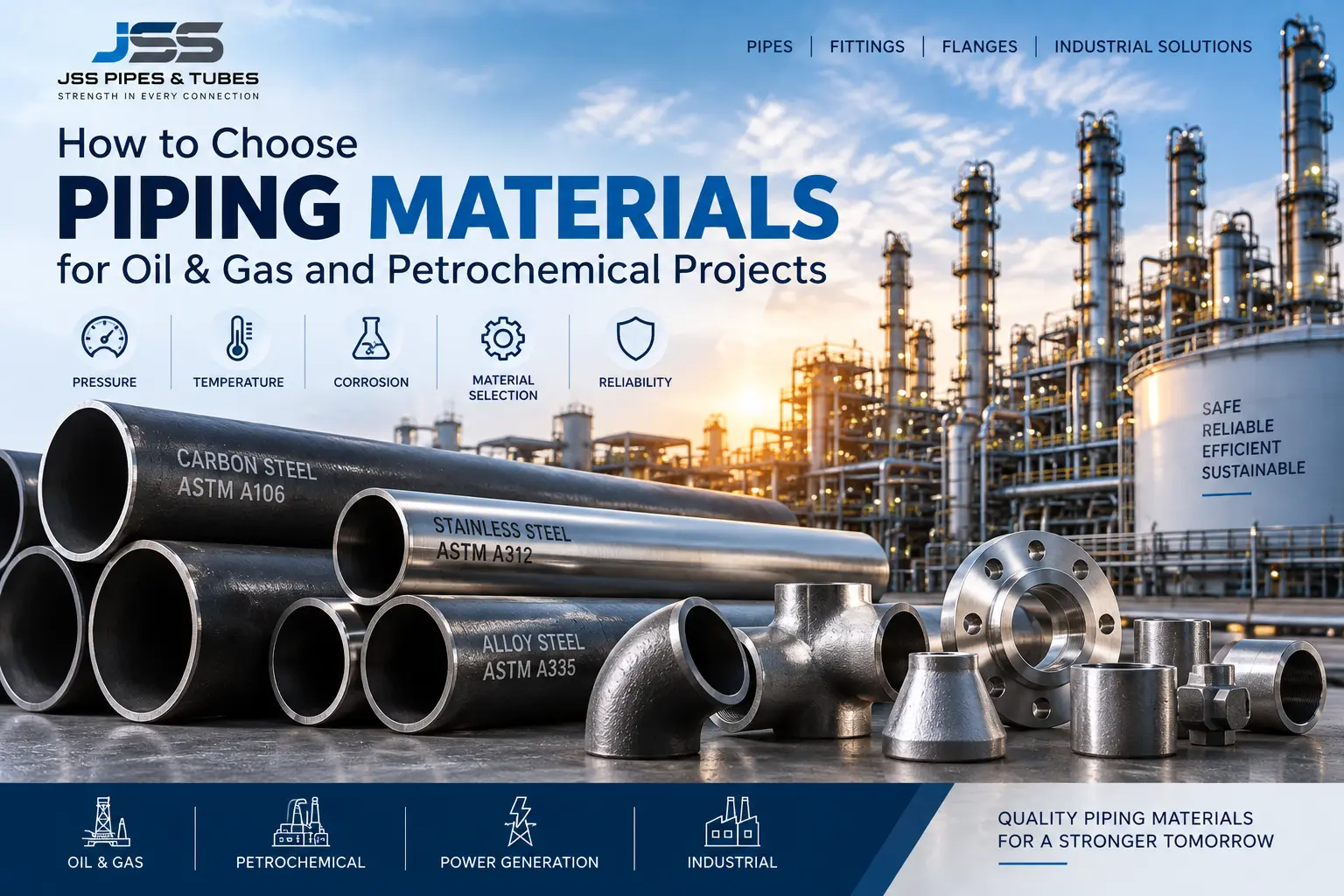
If you are unsure how to read the codes on a line list, see how to read steel pipe specifications and the ASME vs ASTM explainer. For broader material selection across a whole project, read our guide to choosing piping materials for oil, gas and petrochemical projects.
Get the Right Grade From a UAE Stockist
JSS Pipes stocks carbon steel pipe to ASTM A106, A53 and API 5L, along with A333 low-temperature and A312 stainless pipe, with EN 10204 3.1 mill certificates. As a steel pipe supplier in the UAE, we check every grade, schedule and supplementary requirement against your specification before we quote.
Send us your material list and we will come back with availability and documentation.
FAQs
Can A53 replace A106? Only if the engineer approves it. A106 is seamless and made from killed steel for high-temperature service. A53 is not intended for hot process lines.
Is API 5L the same as A106? No. A106 is a process piping specification, while API 5L is a line pipe specification. Triple-certified pipe meets both, but the standards themselves are separate.
What does PSL2 mean? Product Specification Level 2 in API 5L. It adds tighter chemistry, a maximum yield limit, mandatory impact testing and full traceability.
What is the difference between A106 Grade B and Grade C? Grade C has higher minimum strength: 275 MPa yield and 485 MPa tensile, compared with 240 and 415 MPa for Grade B.
Which pipe grade is used for low temperatures? ASTM A333 Grade 6 is the common choice. It is impact-tested at −45 °C.