Understanding the Role of ASME and ASTM Standards in Industrial Piping Systems
Industrial piping systems are designed to operate under demanding conditions, including high pressure, elevated temperatures, corrosive environments, and continuous operation. To ensure these systems are safe, reliable, and compliant, engineers follow internationally recognized standards during design, manufacturing, installation, and inspection.
Two of the most frequently referenced organizations in industrial piping are ASME (American Society of Mechanical Engineers) and ASTM International (formerly the American Society for Testing and Materials). Although these names are often mentioned together, they serve different purposes.
A common misconception is that ASME and ASTM are competing standards. In reality, they complement one another. ASME defines how piping systems should be designed, fabricated, and installed, while ASTM specifies the material properties and quality requirements for the pipes, fittings, and other components used within those systems.
Understanding the difference between ASME and ASTM helps engineers, EPC contractors, procurement professionals, and project managers select the correct materials while ensuring compliance with international engineering practices.
What Is the Difference Between ASME and ASTM?
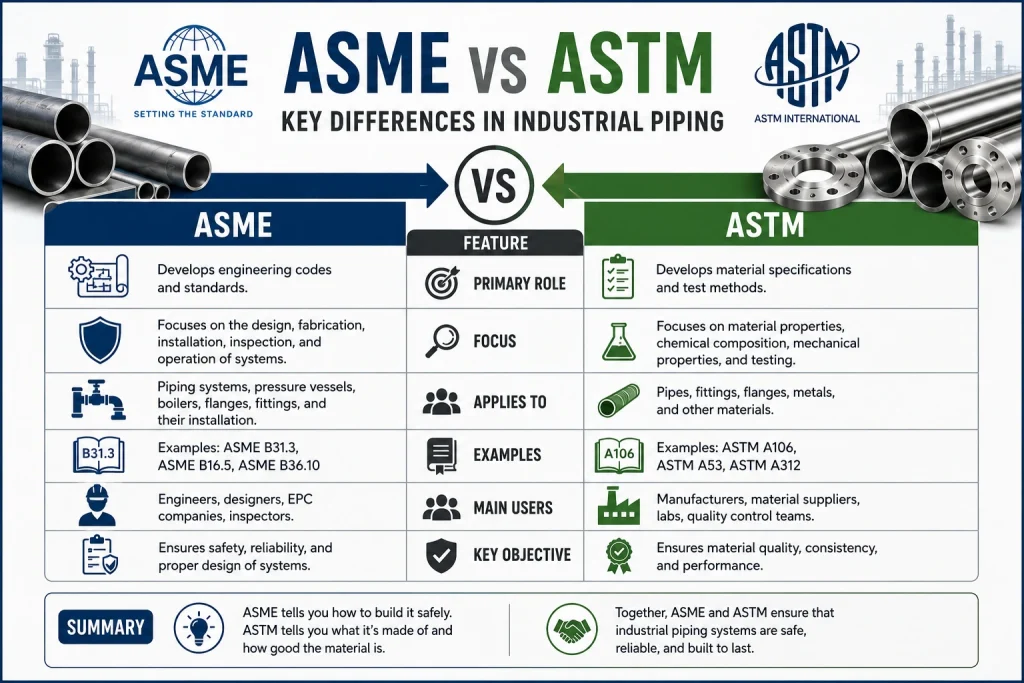
ASME and ASTM have different but complementary roles in industrial piping. ASME develops engineering codes and design standards that govern the design, fabrication, installation, inspection, and operation of piping systems. ASTM develops material specifications that define the chemical composition, mechanical properties, manufacturing processes, and testing requirements of steel pipes, fittings, flanges, and other industrial materials. Together, ASME and ASTM help ensure industrial piping systems are safe, reliable, and compliant with international standards.
What Is ASME?
ASME (American Society of Mechanical Engineers) is an international organization that develops engineering codes and standards used across industries such as oil & gas, petrochemical, power generation, manufacturing, marine, and infrastructure.
Rather than specifying the material itself, ASME establishes how engineering systems should be designed, constructed, inspected, tested, and operated.
These standards help ensure that piping systems perform safely under expected operating conditions throughout their service life.
Engineers worldwide rely on ASME standards because they provide consistent engineering requirements for pressure-containing equipment and industrial piping.
What Does ASME Cover?
ASME standards typically govern:
- Piping system design
- Pressure vessel design
- Boiler construction
- Flange dimensions
- Pipe dimensions
- Welding requirements
- Inspection procedures
- Pressure testing
- Safety requirements
These codes are widely adopted in EPC projects and industrial facilities where safety and regulatory compliance are essential.
Common ASME Standards Used in Industrial Piping
Several ASME standards are frequently referenced when designing industrial piping systems.
ASME B31.3 – Process Piping
ASME B31.3 is one of the most widely used piping codes in the world.
It provides requirements for:
- Process piping design
- Material selection
- Welding procedures
- Pressure testing
- Inspection
- Safety considerations
Industries using ASME B31.3 include:
- Oil & Gas
- Petrochemical
- Chemical Processing
- Pharmaceutical Manufacturing
- Food Processing
ASME B36.10
This standard specifies the dimensions of welded and seamless steel pipes, including outside diameter, wall thickness, and pipe schedules such as SCH 40, SCH 80, and SCH 160.
It helps ensure dimensional consistency across manufacturers and simplifies compatibility between pipes and fittings.
ASME B36.19
ASME B36.19 focuses specifically on stainless steel pipes and defines their standard dimensions and schedules.
It is commonly referenced in industries requiring excellent corrosion resistance, such as food processing, pharmaceuticals, chemical plants, and marine applications.
ASME B16.5
ASME B16.5 specifies dimensions, pressure ratings, tolerances, materials, and marking requirements for pipe flanges and flanged fittings.
Proper flange compatibility is essential for maintaining leak-free piping systems operating under pressure.
What Is ASTM?
ASTM International is one of the world’s leading standards organizations responsible for developing material specifications across thousands of industrial products.
Unlike ASME, ASTM does not specify how a piping system should be designed.
Instead, ASTM standards define the quality and properties of the materials used.
These specifications ensure consistency between manufacturers by establishing requirements for:
- Chemical composition
- Mechanical properties
- Manufacturing methods
- Heat treatment
- Testing procedures
- Material identification
- Product quality
Because of these standardized requirements, engineers can confidently specify materials knowing they meet consistent performance criteria.
What Does ASTM Cover?
ASTM standards define:
- Carbon steel pipes
- Stainless steel pipes
- Alloy steel pipes
- Pipe fittings
- Flanges
- Structural steel
- Fasteners
- Metals
- Testing methods
Every ASTM specification contains detailed requirements regarding manufacturing, testing, inspection, certification, and acceptance criteria.
Common ASTM Standards Used for Steel Pipes
Several ASTM standards are widely used throughout industrial piping projects.
ASTM A106
ASTM A106 covers seamless carbon steel pipes intended for high-temperature service.
These pipes are commonly used in:
- Refineries
- Power plants
- Petrochemical facilities
- Steam systems
- High-pressure process piping
Many industrial projects source these products from experienced Carbon Steel Pipe Suppliers UAE to ensure compliance with ASTM specifications and project requirements.
ASTM A53
ASTM A53 applies to welded and seamless carbon steel pipes used for mechanical and pressure applications.
Typical applications include:
- Water transmission
- Air systems
- Steam piping
- Structural applications
- General industrial services
ASTM A312
ASTM A312 specifies seamless and welded stainless steel pipes designed for high-temperature and corrosive service.
These pipes are widely used in:
- Chemical processing
- Pharmaceutical manufacturing
- Marine installations
- Food processing
- Water treatment plants
Industries requiring corrosion-resistant piping often work with trusted SS Pipes & Fittings Suppliers UAE to obtain ASTM-compliant stainless steel products.
ASME vs ASTM: Key Differences
Although both organizations contribute to industrial piping, they focus on different aspects of engineering.
Feature | ASME | ASTM |
Primary Purpose | Engineering Codes & Design Standards | Material Specifications |
Focus | System Design & Safety | Material Quality |
Covers | Design, Fabrication, Installation | Chemical & Mechanical Properties |
Applies To | Entire Piping Systems | Pipes, Fittings & Materials |
Example Standard | ASME B31.3 | ASTM A106 |
Main Users | Engineers & Designers | Manufacturers & Material Suppliers |
The simplest way to remember the difference is:
- ASME tells engineers how to design and build the piping system.
- ASTM tells manufacturers how the material should be produced and tested.
Why Both Standards Matter in Industrial Piping
Industrial piping projects rarely rely on a single standard. In practice, ASME and ASTM work together to ensure that piping systems are designed safely while using materials that meet strict quality and performance requirements.
For example, an engineer may design a process pipeline according to ASME B31.3, but specify ASTM A106 Grade B seamless carbon steel pipes for the actual material.
This combination ensures that:
- The piping system is designed according to recognized engineering codes.
- The pipe material meets defined chemical and mechanical properties.
- Manufacturing and testing requirements are verified.
- The completed system complies with project specifications and international standards.
Working with a reliable Steel Pipe Supplier UAE also helps ensure that both engineering codes and material specifications are correctly followed throughout the procurement process.
How Engineers Use ASME and ASTM Together
Understanding the relationship between ASME and ASTM becomes easier when looking at a typical industrial project.
Step 1: Design the Piping System
The engineering team first selects the applicable ASME code based on the project.
For example:
- ASME B31.3 – Process Piping
- ASME B31.1 – Power Piping
- ASME B16.5 – Pipe Flanges
These standards define how the piping system should be designed, fabricated, welded, inspected, and tested.
Step 2: Select the Material
Once the design is complete, engineers choose materials that satisfy the required ASTM specifications.
Examples include:
- ASTM A106 for seamless carbon steel pipes
- ASTM A53 for welded or seamless carbon steel pipes
- ASTM A312 for stainless steel pipes
- ASTM A234 for carbon steel butt weld fittings
These specifications ensure that every component meets the required material properties before installation.
Step 3: Manufacturing and Inspection
Manufacturers produce pipes, fittings, and flanges according to ASTM specifications.
Each product undergoes testing for:
- Chemical composition
- Mechanical strength
- Dimensional accuracy
- Hydrostatic testing
- Material traceability
Only products meeting the specified ASTM requirements are accepted for industrial use.
Step 4: Installation and Testing
During installation, contractors follow the applicable ASME code to ensure proper welding procedures, inspection methods, pressure testing, and overall system safety.
This coordinated approach helps deliver a piping system that is both structurally sound and built using certified materials.
Real-World Example
Consider a refinery project installing a high-pressure steam pipeline.
The design engineer specifies:
- ASME B31.3 for piping design and fabrication.
- ASME B16.5 for flange dimensions and pressure classes.
- ASTM A106 Grade B for seamless carbon steel pipes.
- ASTM A234 WPB for carbon steel butt weld fittings.
In this example:
- ASME standards determine how the piping system is designed and assembled.
- ASTM standards determine what materials are used and the quality they must meet.
This combination ensures compatibility, reliability, and compliance throughout the project lifecycle.
Common Mistakes When Interpreting ASME and ASTM Standards
Many professionals new to industrial piping assume ASME and ASTM perform the same function. However, confusing these standards can lead to specification errors and procurement issues.
Avoid these common mistakes:
Assuming ASME Specifies Material Grades
ASME primarily focuses on engineering design and construction requirements. Material grades are generally defined by ASTM specifications.
Treating ASTM as a Design Code
ASTM specifies how materials should be manufactured and tested but does not provide piping system design rules.
Ignoring Project Specifications
Different projects may require specific combinations of ASME codes and ASTM material standards. Always review project documentation before selecting materials.
Overlooking Material Certification
Requesting mill test certificates (MTCs) and verifying compliance with ASTM specifications helps ensure product quality and traceability.
Choosing Materials Based Only on Cost
Lower-cost materials may not satisfy project specifications or required ASTM standards, potentially affecting safety and long-term performance.
Best Practices for Standard Compliance
To ensure reliable industrial piping systems, engineers and procurement teams should follow these best practices:
- Use the appropriate ASME code for system design.
- Select ASTM-compliant materials for all piping components.
- Verify mill test certificates before installation.
- Confirm compatibility between pipes, fittings, valves, and flanges.
- Purchase products from trusted industrial suppliers.
- Follow project specifications and international engineering standards throughout the project lifecycle.
These practices help reduce installation errors, improve operational safety, and extend the service life of piping systems.
Conclusion
Although ASME and ASTM are often mentioned together, they perform different yet equally important roles in industrial piping. ASME establishes the engineering codes and design requirements that govern how piping systems are built, while ASTM defines the material specifications that ensure pipes, fittings, and flanges meet consistent quality and performance standards.
Understanding how these organizations complement each other enables engineers, EPC contractors, and procurement professionals to make informed decisions when selecting piping components. By following both ASME and ASTM standards, industrial projects can achieve higher levels of safety, reliability, regulatory compliance, and long-term operational performance.
Partnering with an experienced pipe supplier in UAE further helps ensure access to certified piping products that meet internationally recognized engineering and material standards.
Frequently Asked Questions
Q1. What is the difference between ASME and ASTM?
Ans – ASME develops engineering codes and design standards for piping systems, while ASTM develops material specifications that define the chemical composition, mechanical properties, manufacturing methods, and testing requirements of industrial materials.
Q2. Is ASME the same as ASTM?
Ans – No. Although both organizations publish internationally recognized standards, ASME focuses on engineering design and safety, whereas ASTM focuses on material quality and specifications.
Q3. Why are both ASME and ASTM important in industrial piping?
Ans – ASME ensures piping systems are designed and installed safely, while ASTM ensures the materials used meet the required quality, strength, and performance standards.
Q4. What is ASME B31.3?
Ans – ASME B31.3 is the internationally recognized code for the design, fabrication, inspection, testing, and maintenance of process piping systems used in industries such as oil & gas, petrochemical, and chemical processing.
Q5. What is ASTM A106 used for?
Ans – ASTM A106 specifies seamless carbon steel pipes intended for high-temperature and high-pressure service in industries such as refineries, power plants, and petrochemical facilities.
Q6. Can a pipe comply with both ASME and ASTM?
Ans – Yes. A piping system can be designed according to ASME standards while using pipes manufactured in accordance with ASTM material specifications. This is common practice in industrial projects.
Q7. Which industries use ASME and ASTM standards?
Ans – Oil & gas, petrochemical, power generation, marine, chemical processing, manufacturing, water treatment, and infrastructure projects commonly rely on both ASME and ASTM standards.
Q8. Are ASME and ASTM international standards?
Ans – Yes. Although both organizations originated in the United States, their standards are widely adopted and recognized across industrial projects worldwide.
Q9. How do engineers choose the correct standard?
Ans – Engineers first identify the applicable ASME design code for the project and then select ASTM-compliant materials that satisfy the required operating conditions and project specifications.
Q10. Why should buyers verify ASTM certification?
Ans – Verifying ASTM certification helps confirm that pipes and fittings meet the required material composition, mechanical properties, testing requirements, and manufacturing standards before installation.