When selecting pipe fittings for an industrial piping system, the manufacturing method can be just as important as the material, size, pressure requirements, and applicable standard. Two common manufacturing approaches are forging and casting, and each offers different characteristics that can make it suitable for specific applications.
Forged and cast fittings are used across industries such as oil and gas, petrochemical processing, power generation, chemical processing, and general industrial piping. However, choosing between them requires more than simply comparing price or assuming that one manufacturing method is always superior.
The right selection depends on factors such as pressure, temperature, material, fitting design, pipe size, service conditions, applicable standards, testing requirements, and project specifications.
This guide explains the difference between forged and cast fittings, their manufacturing processes, advantages, applications, and the key factors engineers and procurement teams should consider before making a selection.
What Are Forged Fittings?
Forged fittings are pipe fittings manufactured by mechanically deforming metal under controlled force.
During the forging process, a suitable metal billet or preform is heated to an appropriate temperature and then shaped using equipment such as presses or forging machinery.
The controlled deformation changes the shape of the material and can influence its grain structure and mechanical properties.
Forged fittings are commonly manufactured for applications where compact dimensions, mechanical strength, and pressure performance are important considerations.
Common forged fitting configurations include:
- Elbows
- Tees
- Couplings
- Unions
- Crosses
- Bushings
- Plugs
- Caps
The exact range depends on the applicable product standard and manufacturer.
How Are Forged Fittings Manufactured?
The general forging process involves several stages.
1. Material Selection
The manufacturer starts with a suitable metal or alloy according to the required material specification.
Common materials can include:
- Carbon steel
- Stainless steel
- Alloy steel
The selected material must meet the applicable chemical and mechanical requirements.
2. Heating
The metal is heated to a suitable forging temperature.
The temperature must be controlled carefully because forging behavior depends on the material and manufacturing process.
3. Forming
The heated material is placed into forging equipment and shaped using controlled mechanical force.
Depending on the fitting design, the manufacturing process may involve dies, presses, or other forming methods.
4. Heat Treatment
Depending on the material specification and product requirements, heat treatment may be required to achieve the specified mechanical properties.
The applicable standard determines the relevant requirements.
5. Machining
After forging and any required heat treatment, machining may be carried out to achieve the required:
- Dimensions
- Thread profiles
- Socket dimensions
- Surface finish
- Connection geometry
6. Inspection and Testing
The finished fitting may undergo inspections and tests required by the applicable standard and purchase specification.
These can include:
- Dimensional inspection
- Visual examination
- Chemical analysis
- Mechanical testing
- Hardness testing
- Non-destructive examination where specified
Material documentation and traceability may also be required for industrial projects.
What Are Cast Fittings?
Cast fittings are produced by pouring molten metal into a mold designed to create the required fitting shape.
Once the molten material enters the mold, it cools and solidifies. The resulting casting is then processed and finished to achieve the required dimensions and surface characteristics.
One of the major advantages of casting is its ability to produce complex geometries that may be difficult or inefficient to manufacture through forging.
Depending on the application, cast products can be manufactured from various materials and in different shapes and sizes.
The suitability of a cast fitting depends on the applicable product standard, material, manufacturing quality, inspection requirements, and intended service.
How Are Cast Fittings Manufactured?
The general casting process includes several stages.
1. Pattern and Mold Preparation
A pattern representing the required component geometry is used to prepare the mold.
The mold must be designed to produce the required dimensions and shape.
2. Melting the Material
The selected metal or alloy is melted in a controlled furnace.
Chemical composition is monitored to ensure that the material meets the required specification.
3. Pouring
The molten metal is poured into the prepared mold.
The metal fills the required cavity and begins to cool.
4. Solidification
As the material cools, it solidifies into the required fitting shape.
The cooling and solidification process must be properly controlled to achieve the required product quality.
5. Finishing and Machining
Once the casting has solidified, additional operations can include:
- Removing excess material
- Surface cleaning
- Heat treatment
- Machining
- Connection preparation
6. Inspection and Testing
Depending on the applicable standard and project requirements, cast fittings can undergo inspection and testing for:
- Dimensions
- Surface condition
- Chemical composition
- Mechanical properties
- Casting quality
- Non-destructive examination where required
Forged vs Cast Fittings: Manufacturing Difference
The fundamental difference between the two products is how the metal is formed.
Forging
The material is mechanically shaped using controlled force.
Basic process:
Metal billet → Heating → Mechanical deformation → Heat treatment → Machining → Inspection
Casting
The material is melted and poured into a mold.
Basic process:
Raw material → Melting → Mold filling → Solidification → Finishing → Machining → Inspection
This difference in manufacturing can influence the fitting’s material structure, geometry, production method, and suitability for specific applications.
However, manufacturing method alone does not determine the quality or suitability of a fitting. The material specification, design, manufacturing controls, heat treatment, inspection, and applicable standard must also be considered.
Common Types of Forged Fittings
Forged fittings are commonly associated with compact piping connections and are available in several configurations.
Forged Elbows
Forged elbows are used to change the direction of a piping run.
Common configurations include:
- 45-degree elbows
- 90-degree elbows
The appropriate configuration depends on the piping layout and connection requirements.
Forged Tees
A forged tee provides a branch connection from the main piping run.
It can be used where a smaller or comparable branch needs to connect to the main line, depending on the fitting design and applicable standard.
Forged Couplings
Couplings are used to connect two pipe sections or components.
Depending on the design, they can be supplied with threaded or socket-weld connections.
Forged Unions
Unions provide a detachable connection between piping components and can be useful where disassembly or maintenance access is required.
Forged Bushings
Bushings are used to connect components with different connection sizes, depending on the fitting design.
Common Applications of Forged Fittings
Forged fittings are commonly considered for industrial services where compact connections and demanding operating conditions are important.
Applications can include:
- Oil and gas piping
- Petrochemical plants
- Chemical processing
- Power generation
- Process piping
- High-pressure utility systems
- Instrumentation connections
- Industrial manufacturing systems
The actual suitability must always be confirmed against the project’s pressure, temperature, material, size, connection, and code requirements.
Common Types of Cast Fittings
Cast fittings can be manufactured in a wide range of configurations because casting provides considerable freedom in component geometry.
Depending on the applicable product category and standard, cast components can include:
- Elbows
- Tees
- Crosses
- Reducers
- Specialty fittings
- Complex-shaped piping components
Casting can be particularly useful when the required geometry would be difficult to produce efficiently through conventional forging.
Common Applications of Cast Fittings
Cast fittings and cast piping components can be used across many industrial environments, depending on their material, design, standard, and service requirements.
Potential applications include:
- General industrial piping
- Water systems
- Process systems
- Chemical applications
- Industrial utilities
- Specialized piping systems
A cast fitting should not be selected solely because the application is considered “general purpose.” The pressure, temperature, fluid, material compatibility, and applicable specifications still need to be evaluated.
Forged vs Cast Fittings: What’s the Difference?
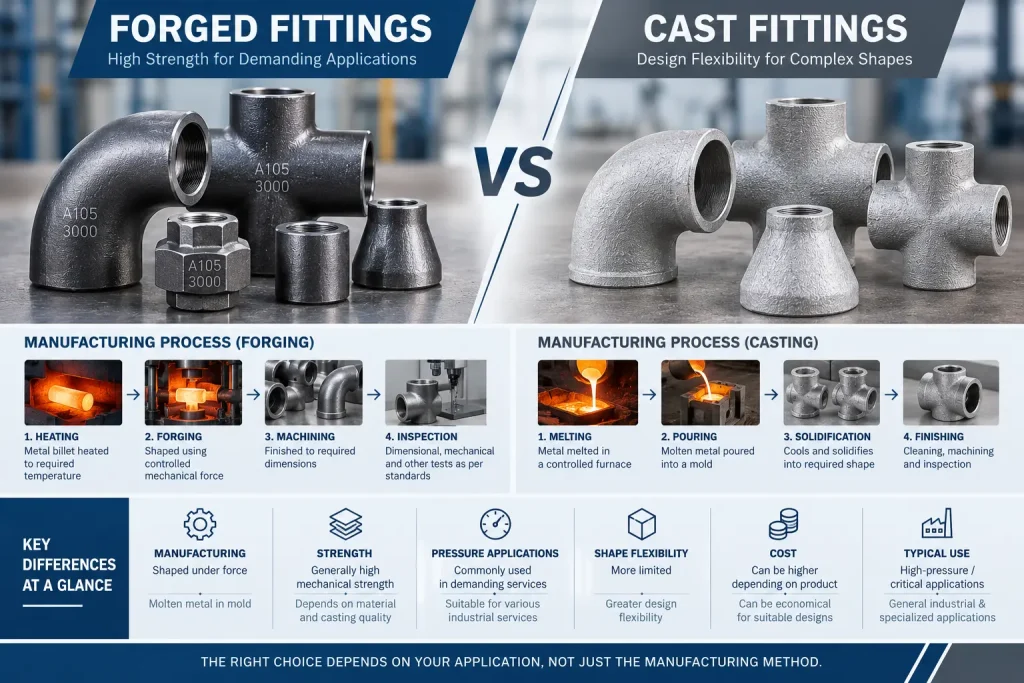
The differences become easier to understand when the two manufacturing methods are compared directly.
Important:
There is no universal rule that says:
Forged = always better
or:
Cast = always inferior
The correct choice depends on the actual engineering requirements.
Forged vs Cast Fittings: Which Is Stronger?
This is one of the most common questions engineers and buyers ask.
Forging can produce a favorable grain structure and high mechanical performance in many applications because the material is shaped through controlled deformation.
However, it would be inaccurate to claim that every forged fitting is stronger than every cast fitting.
The actual performance depends on:
- Material grade
- Manufacturing process
- Heat treatment
- Component design
- Dimensions
- Manufacturing quality
- Inspection
- Applicable standard
For pressure-containing industrial components, engineers should therefore compare products based on their specified mechanical and pressure requirements, rather than manufacturing method alone.
What Makes Forged Fittings Suitable for Demanding Applications?
Forged fittings are often considered for demanding applications because their manufacturing process can provide favorable mechanical characteristics when properly controlled.
They are particularly common in:
- High-pressure piping
- Compact piping systems
- Process connections
- Oil & gas facilities
- Petrochemical systems
- Power plants
However, the final selection should always be based on the applicable standard and project design requirements.
What Makes Cast Fittings Useful?
Casting offers an important manufacturing advantage: design flexibility.
Because molten metal can flow into a mold, casting can accommodate geometries that may be difficult to manufacture through forging.
This can be useful for:
- Complex component shapes
- Specialized designs
- Certain large components
- Applications requiring particular geometries
Again, the appropriate choice depends on the component specification and operating requirements.
Forged vs Cast Fittings for High-Pressure Applications
Pressure is one of the most important factors when selecting a pipe fitting. The fitting must be capable of handling the system’s design pressure and temperature while maintaining the required mechanical integrity.
Forged fittings are commonly used in demanding pressure applications, particularly for compact piping connections. Their manufacturing process involves controlled mechanical deformation of the material, which can provide favorable mechanical properties when the correct material, process, and heat treatment are used.
However, the manufacturing method alone does not determine whether a fitting is suitable for high-pressure service.
Engineers should verify:
- Design pressure
- Design temperature
- Material grade
- Fitting dimensions
- Connection type
- Pressure class
- Applicable standard
- Heat treatment
- Testing and inspection requirements
A fitting should therefore be selected based on its complete pressure-temperature and material requirements, not simply because it is forged or cast.
Forged Fittings for Oil & Gas Applications
Oil and gas facilities contain piping systems that can operate under demanding pressure, temperature, and service conditions.
Forged fittings are widely considered for applications such as:
- Process piping
- Hydrocarbon lines
- High-pressure connections
- Instrumentation piping
- Refinery systems
- Gas processing facilities
- Pipeline-related systems
The fitting specification may need to address material requirements, pressure class, dimensions, connection type, testing, and traceability.
For critical oil and gas projects, engineers and procurement teams should also verify the project-specific requirements in addition to the applicable ASTM and ASME standards.
For industrial projects requiring specification-compliant components, JSS Pipes & Fittings Trading LLC can supply forged fittings and flanges for various industrial piping applications.
Forged Fittings for Petrochemical Applications
Petrochemical plants contain complex piping networks used to transport hydrocarbons, chemicals, steam, utilities, and process fluids.
Depending on the application, forged fittings can be considered for:
- Process piping
- High-pressure lines
- Utility systems
- Chemical processing connections
- Instrumentation systems
- Refinery applications
- High-temperature services
Material selection is particularly important in these environments.
Engineers may need to evaluate:
- Corrosion resistance
- Temperature
- Pressure
- Fluid compatibility
- Material strength
- Weldability
- Applicable standards
The fitting selected should be compatible with the pipe, flange, valve, gasket, and other connected components.
Standards for Forged Fittings
Standards help define the technical requirements that manufacturers and users need to follow.
Two important standards frequently encountered with forged fittings are ASME B16.11 and applicable ASTM material specifications.
ASME B16.11
ASME B16.11 covers forged fittings, including socket-welding and threaded fittings.
It establishes requirements related to areas such as:
- Dimensions
- Pressure-temperature ratings
- Marking
- Tolerances
- Materials covered by the standard
The exact fitting requirements should always be verified against the applicable edition and project specification.
ASTM A105
ASTM A105 is commonly associated with forged carbon steel piping components.
It covers requirements for forged carbon steel piping components for ambient and higher-temperature service in pressure systems.
Depending on the component and application, the material specification should be checked carefully against the purchase requirement.
ASTM A182
ASTM A182 covers forged or rolled alloy and stainless steel flange, forged fittings, and valves and parts for high-temperature service.
It includes various material grades, making it important to specify the exact grade rather than simply requesting “stainless steel” or “alloy steel.”
Why Material Grade Matters
The same fitting shape can be manufactured from different materials.
For example, an elbow may be available in:
- Carbon steel
- Stainless steel
- Alloy steel
But the material choice should depend on the service conditions.
Important considerations include:
Pressure
Higher-pressure services require appropriate material strength and component ratings.
Temperature
Material properties can change with temperature, so the design temperature must be considered.
Corrosion
The fluid and environment can influence the required corrosion resistance.
Compatibility
The fitting must be compatible with the connected pipe and other components.
Forged vs Cast Fittings: Connection Type
Connection type is another important selection factor.
Common fitting connections include:
- Threaded
- Socket weld
- Butt weld
- Flanged connections where applicable
Forged fittings are commonly available in threaded and socket-weld configurations under applicable standards.
For larger piping systems, butt-weld fittings are also widely used, with their own applicable dimensional and material requirements.
The connection should match:
- Pipe dimensions
- Piping design
- Pressure requirements
- Installation method
- Maintenance requirements
- Applicable standard
Pressure Class and Forged Fittings
Pressure class is particularly important when selecting forged fittings.
For example, socket-weld and threaded forged fittings may be specified with pressure classes such as:
- Class 2000
- Class 3000
- Class 6000
- Class 9000
The applicable pressure-temperature rating depends on the fitting material, class, temperature, and relevant standard.
Therefore, a fitting should never be selected by looking at its Class number alone.
Important:
Pressure class is not the same as a universal pressure value.
The allowable pressure must be verified against the applicable standard and temperature conditions.
Forged vs Cast Fittings: Cost Considerations
Cost is an important factor in procurement, but it should not be the only selection criterion.
The overall cost of a fitting can depend on:
- Material
- Size
- Pressure class
- Manufacturing method
- Quantity
- Machining requirements
- Heat treatment
- Testing
- Certification
- Availability
- Delivery requirements
Forged fittings may be more appropriate for certain demanding applications, while cast components can provide manufacturing flexibility for specific geometries.
The lowest initial purchase price does not necessarily represent the lowest project cost.
Engineers and procurement teams should consider:
Purchase Cost + Availability + Compliance + Installation + Maintenance + Service Requirements
Quality and Inspection of Forged and Cast Fittings
Quality control is important for both forged and cast components.
Depending on the product specification and project requirements, inspection can include:
- Visual examination
- Dimensional inspection
- Chemical analysis
- Mechanical testing
- Hardness testing
- Pressure testing where applicable
- Non-destructive examination
- Material traceability
The exact inspection requirements depend on the applicable standard and purchase specification.
For critical projects, inspection documentation should be reviewed before the material is accepted.
Material Test Certificate and Traceability
A Material Test Certificate (MTC) provides important information about the supplied material and its compliance with specified requirements.
Depending on the product and standard, documentation can include:
- Manufacturer
- Material specification
- Grade
- Heat number
- Chemical composition
- Mechanical test results
- Heat treatment information
- Dimensions
- Inspection results
The heat number is especially useful for maintaining material traceability.
For EPC, oil & gas, and petrochemical projects, proper traceability can be an important part of material control.
When Should You Choose Forged Fittings?
Forged fittings may be considered when the application requires:
- High mechanical strength
- Demanding pressure conditions
- Compact connections
- Threaded connections
- Socket-weld connections
- Critical industrial service
- Specific pressure classes
- Compliance with applicable forged-fitting standards
However, engineers should still evaluate the complete technical requirements before making the final selection.
When Should You Choose Cast Fittings?
Cast fittings may be considered when the application benefits from:
- Complex geometries
- Specialized shapes
- Particular component configurations
- Manufacturing flexibility
- Suitable material and casting options
Cast does not automatically mean unsuitable for industrial service.
The important factors remain:
Material + Design + Manufacturing Quality + Testing + Service Conditions + Applicable Standard
Forged vs Cast Fittings: Quick Selection Guide
Requirement | Forged Fittings | Cast Fittings |
High-pressure compact piping | Often considered | Application dependent |
Threaded connections | Common | Depends on product |
Socket-weld connections | Common | Depends on product |
Complex geometry | More limited | Often advantageous |
Specialized shapes | Evaluate application | Can offer greater flexibility |
Oil & gas | Common in suitable applications | Application dependent |
Petrochemical | Common in suitable applications | Application dependent |
Material flexibility | Available in many grades | Available in many grades |
Selection priority | Pressure, material, size, standard | Geometry, material, service, standard |
Final decision | Project specification | Project specification |
How to Choose Between Forged and Cast Fittings
Use the following process before placing an order.
1. Identify the Service
Determine what fluid will flow through the piping system.
For example:
- Oil
- Gas
- Water
- Steam
- Chemicals
- Hydrocarbons
2. Determine Design Pressure
Identify the pressure the fitting needs to withstand under the project’s design conditions.
Do not rely only on normal operating pressure.
3. Determine Design Temperature
Temperature can affect material allowable stresses and pressure-temperature ratings.
4. Select the Material
Choose the appropriate material based on:
- Strength
- Corrosion resistance
- Temperature
- Fluid compatibility
- Project requirements
5. Select the Fitting Type
Determine whether the application requires:
- Elbow
- Tee
- Coupling
- Union
- Cross
- Bushing
- Reducer
- Other specialized fitting
6. Select the Connection
Check whether the fitting requires:
- Threaded
- Socket weld
- Butt weld
- Other specified connection
7. Verify the Standard
Confirm the applicable:
- ASME standard
- ASTM material specification
- API/project specification where applicable
8. Verify Documentation
Before accepting the material, check:
- MTC
- Heat number
- Grade
- Chemical composition
- Mechanical properties
- Dimensions
- Testing
- Inspection requirements
Common Mistakes When Choosing Forged vs Cast Fittings
Assuming Forged Is Always Better
Forged fittings can offer advantages for certain applications, but that does not make every forged fitting automatically better than every cast fitting.
Choosing Based Only on Price
A lower purchase price may not mean lower total project cost.
Availability, certification, testing, installation, and service requirements should also be considered.
Ignoring Pressure and Temperature
A fitting must be suitable for the actual design conditions.
Choosing the Wrong Material
Material compatibility is essential, especially in corrosive or high-temperature services.
Ignoring Standards
The fitting should comply with the applicable product, dimensional, and project requirements.
Mixing Incompatible Components
Pipe, fittings, flanges, valves, gaskets, and other components need to be evaluated as part of the complete piping system.
Not Checking Documentation
For industrial projects, material certificates and traceability records should be reviewed against the purchase specification.
Frequently Asked Questions
Q1. What is the difference between forged and cast fittings?
Ans – Forged fittings are produced by shaping heated metal using controlled mechanical force, while cast fittings are manufactured by pouring molten metal into a mold and allowing it to solidify. Their suitability depends on material, design, service conditions, standards, and project requirements.
Q2. Are forged fittings stronger than cast fittings?
Ans – Forged fittings can provide favorable mechanical properties because of the controlled deformation used during manufacturing. However, it is not accurate to say that every forged fitting is stronger than every cast fitting. Material, design, heat treatment, manufacturing quality, and applicable standards also affect performance.
Q3. Which is better, forged or cast fittings?
Ans – Neither is universally better. Forged fittings are often considered for demanding pressure applications and compact connections, while casting can provide greater flexibility for complex geometries. The correct choice depends on the application’s pressure, temperature, material, size, design, and applicable standards.
Q4. When should forged fittings be used?
Ans – Forged fittings may be selected for applications requiring compact connections, demanding pressure conditions, threaded or socket-weld connections, and specific mechanical or material requirements. The final selection should follow the applicable standard and project specification.
Q5. When are cast fittings preferred?
Ans – Cast fittings can be considered when complex or specialized geometries are required and the selected product meets the project’s material, pressure, temperature, testing, and dimensional requirements.
Q6. Are forged fittings suitable for high-pressure applications?
Ans – Yes, forged fittings are commonly used in many high-pressure piping applications. However, suitability depends on the fitting’s material, pressure class, temperature, dimensions, manufacturing requirements, and applicable standard.
Q7. Are cast fittings suitable for industrial piping?
Ans – Yes. Cast fittings and piping components are used in various industrial applications. Their suitability depends on the specific product, material, design, manufacturing quality, service conditions, and applicable requirements.
Q8. What are the advantages of forged fittings?
Ans – Potential advantages include favorable mechanical properties, compact configurations, and availability in pressure classes and connection types suited to demanding piping applications. The actual benefits depend on the material, manufacturing process, and product specification.
Q9. What are the advantages of cast fittings?
Ans – Casting can provide greater flexibility for producing complex shapes and specialized geometries. It can be suitable for applications where the required component design would be difficult to manufacture efficiently through forging.
Q10. What standards apply to forged fittings?
Ans – Depending on the fitting type and application, standards such as ASME B16.11, ASTM A105, and ASTM A182 may be relevant. The exact standard and material grade should be confirmed against the project specification.
Q11. What materials are used for forged pipe fittings?
Ans – Forged fittings can be manufactured from materials including carbon steel, stainless steel, and alloy steel. The appropriate material depends on pressure, temperature, corrosion, fluid compatibility, and project requirements.
Q12. How do I choose between forged and cast fittings?
Ans – Start by evaluating service conditions, design pressure, design temperature, material, pipe size, fitting geometry, connection type, pressure class, applicable standards, testing, and documentation. The manufacturing method should then be selected based on these requirements.
Conclusion
The choice between forged and cast fittings should be based on engineering requirements rather than the manufacturing method alone.
Forged fittings are commonly considered for demanding pressure applications, compact piping connections, and certain oil & gas and petrochemical services. Cast fittings can provide greater flexibility for complex geometries and specialized component designs.
For either option, engineers should verify the material grade, pressure and temperature requirements, dimensions, connection type, applicable ASME or ASTM standards, inspection requirements, testing, and material traceability.
For EPC contractors, oil & gas companies, petrochemical facilities, and other industrial projects, selecting the right fitting requires coordination between engineering, procurement, and quality teams. A complete technical specification helps ensure that the selected component is compatible with the piping system and suitable for its intended service.
The best fitting is not simply the one that is forged or cast—it is the one that meets the complete requirements of the application.