Understanding Standards, Grades, Sizes, Schedules and Testing Requirements
Steel pipe specifications can look complicated when they contain multiple codes, numbers, grades, dimensions, and manufacturing terms in a single line. For engineers, EPC contractors, procurement teams, and industrial buyers, understanding these specifications is essential before selecting or ordering piping materials.
A typical specification may include information about the material standard, grade, manufacturing method, nominal pipe size, schedule, dimensional standard, pipe ends, and testing requirements. Each part provides important information about how the pipe was manufactured and where it can be used.
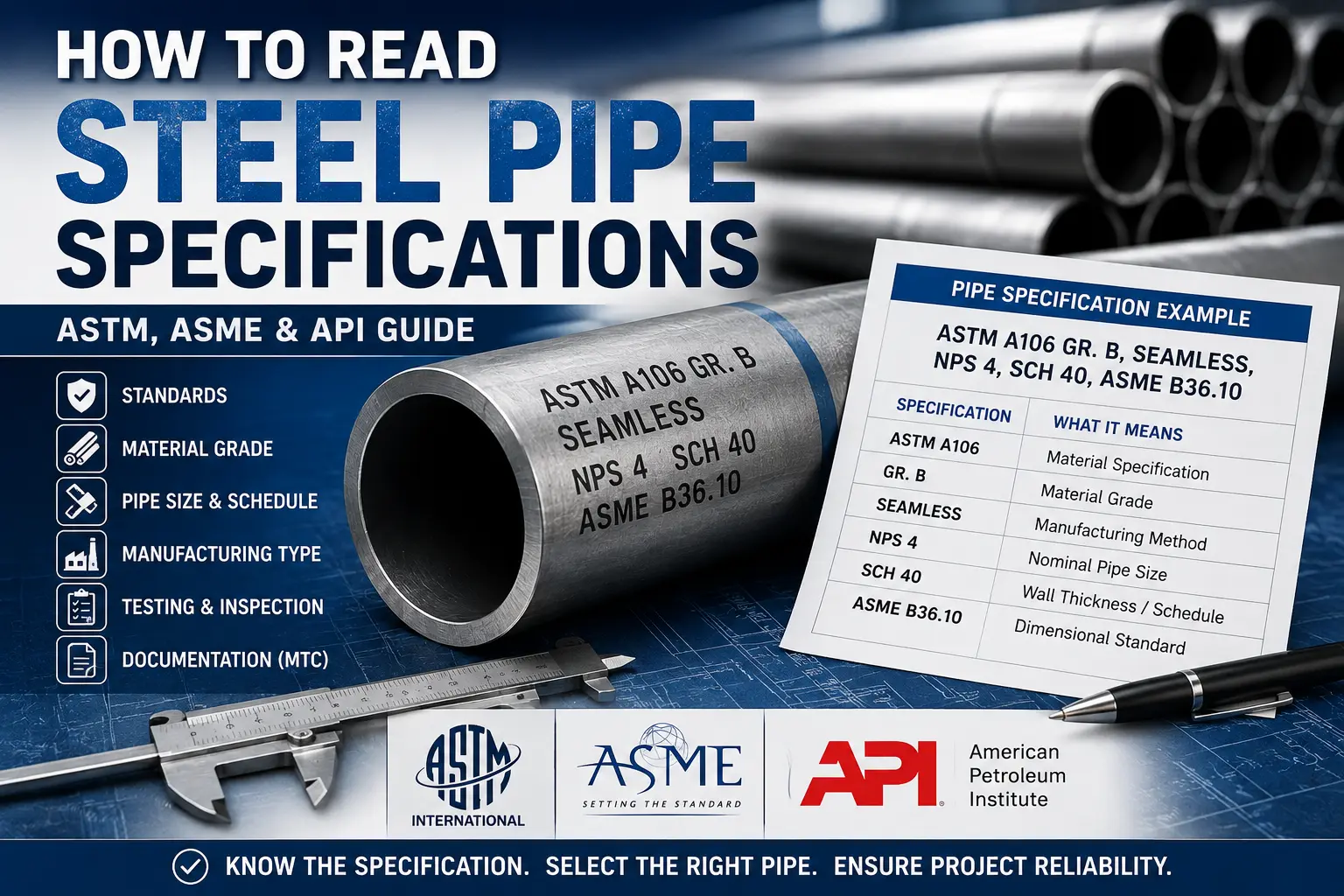
For example, a requirement such as ASTM A106 Grade B, Seamless, NPS 4, SCH 40, ASME B36.10 contains several separate pieces of information. Understanding what each designation means makes it easier to verify whether the pipe is suitable for a particular industrial application.
This guide explains how to read steel pipe specifications step by step, with practical examples covering ASTM, ASME, API, pipe grades, dimensions, schedules, manufacturing methods, and inspection requirements.
How Do You Read a Steel Pipe Specification?
To read a steel pipe specification, first identify the applicable standard such as ASTM, ASME, or API. Then check the material grade, manufacturing method, nominal pipe size, schedule or wall thickness, dimensional standard, pipe end type, and testing requirements. For example, ASTM A106 Grade B, Seamless, NPS 4, SCH 40, ASME B36.10 identifies a seamless carbon steel pipe manufactured to ASTM A106 Grade B requirements, with a nominal size of 4 inches and Schedule 40 dimensions based on ASME B36.10.
What Is a Steel Pipe Specification?
A steel pipe specification is a set of technical requirements that defines the material, manufacturing, dimensions, testing, and quality requirements of a pipe.
A specification can tell you:
- What material the pipe is made from
- Which standard it follows
- What grade it has
- Whether it is seamless or welded
- What its nominal size is
- What wall thickness or schedule it has
- What type of pipe ends are required
- What inspections and tests must be performed
- What certification documents must accompany the material
These details are particularly important for industrial projects where piping must meet specific engineering and safety requirements.
A pipe should therefore never be selected based only on its diameter. The complete specification needs to be reviewed before procurement.
What Information Is Included in a Steel Pipe Specification?
Although specifications vary between projects, most industrial pipe requirements contain several key elements.
The most important ones are:
- Material Standard
- Material Grade
- Manufacturing Method
- Nominal Pipe Size
- Pipe Schedule or Wall Thickness
- Dimensional Standard
- Pipe Length
- End Type
- Testing and Inspection Requirements
- Certification and Documentation
Understanding each element makes technical specifications much easier to interpret.
1. Material Standard
The first thing to identify is usually the material standard.
Standards define the technical requirements that the pipe must satisfy. Depending on the application, you may encounter specifications from organizations such as:
- ASTM
- API
- ASME
For example:
ASTM A106
This is a material specification for seamless carbon steel pipe intended for high-temperature service.
Another example is:
API 5L
This specification covers line pipe used primarily for pipeline transportation applications.
The standard tells you what requirements the material and product need to satisfy. However, the standard alone does not always tell you the complete pipe configuration. Size, grade, schedule, manufacturing method, and project requirements may still need to be specified separately.
2. Material Grade
The material grade identifies a particular level of material performance within a specification.
For example:
- ASTM A106 Grade A
- ASTM A106 Grade B
- ASTM A106 Grade C
- ASTM A53 Grade B
- API 5L Grade B
- API 5L X42
- API 5L X52
- API 5L X65
Different grades can have different requirements for chemical composition and mechanical properties.
When sourcing carbon steel products for industrial applications, Carbon Steel Pipe Suppliers UAE can provide material options according to the required grade, manufacturing method, dimensions, and project specifications.
Why Does Pipe Grade Matter?
The grade helps engineers determine whether the pipe can meet the required:
- Yield strength
- Tensile strength
- Temperature requirements
- Service conditions
- Pressure requirements
- Project specifications
For example, an engineer specifying API 5L X52 is identifying a particular line-pipe grade rather than simply asking for a generic carbon steel pipe.
3. Manufacturing Method
The specification may also identify how the pipe is manufactured.
Common terms include:
Seamless (SMLS)
A seamless pipe is manufactured without a longitudinal welded seam.
It is commonly specified for applications where seamless construction is required by the applicable standard or project specification.
ERW
ERW (Electric Resistance Welded) pipe is manufactured from steel strip or plate with the edges joined using electric resistance welding.
SAW
SAW (Submerged Arc Welding) is a welding process used in the manufacture of certain welded pipes, particularly larger-diameter products.
The manufacturing method can be important because different processes have different dimensional, mechanical, inspection, and application requirements.
4. Nominal Pipe Size (NPS)
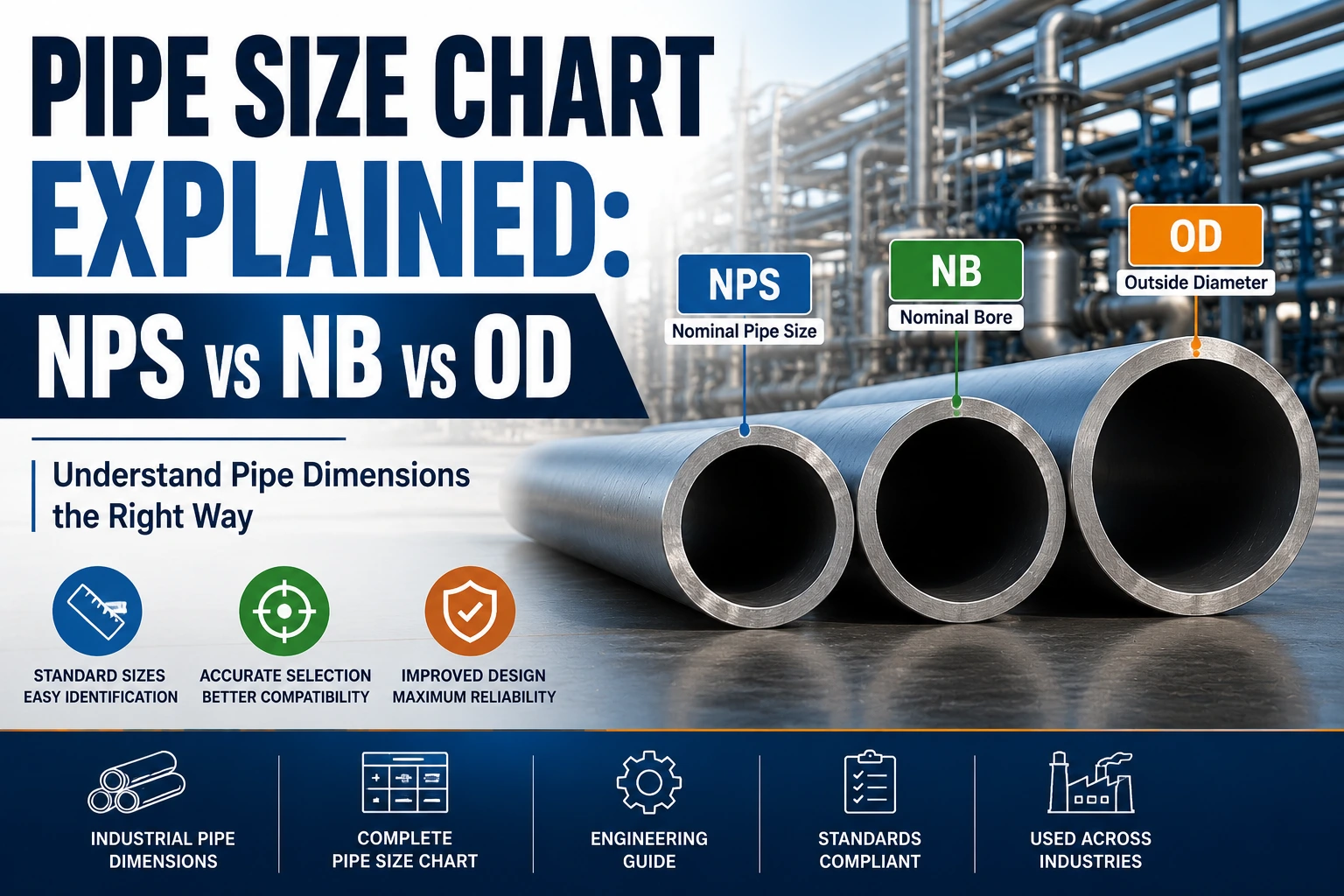
NPS (Nominal Pipe Size) is the standardized designation used to identify pipe size.
It does not always represent the actual outside diameter of the pipe.
For example:
NPS 4 pipe = 4-inch nominal pipe size
But its actual outside diameter is approximately:
4.500 inches (114.3 mm)
This distinction is important when checking compatibility between pipes, fittings, flanges, and other piping components.
For a detailed explanation of NPS, NB, and OD, the pipe size chart should always be consulted rather than assuming that the nominal size equals the measured diameter.
5. Pipe Schedule and Wall Thickness
Pipe schedule indicates a standardized wall-thickness designation.
Common schedules include:
- SCH 10
- SCH 20
- SCH 40
- SCH 80
- SCH 120
- SCH 160
A higher schedule generally indicates a thicker pipe wall for a given nominal size.
For example, an NPS 4 pipe can be available in different schedules. The outside diameter remains standardized for that NPS, while the wall thickness and internal diameter change.
To understand how SCH 40, SCH 80, and SCH 160 affect wall thickness and internal diameter, see our detailed guide to pipe schedule and standard pipe wall thicknesses.
Why Is Pipe Schedule Important?
Schedule affects:
- Wall thickness
- Internal diameter
- Flow area
- Pipe weight
- Pressure capability
- Compatibility with piping components
The correct schedule should be selected according to the system’s design requirements rather than simply choosing the thickest available pipe.
6. Dimensional Standard
A steel pipe specification may also reference a dimensional standard.
One common example is:
ASME B36.10
This standard covers dimensions of welded and seamless wrought steel pipes.
For stainless steel piping, another commonly referenced dimensional standard is:
ASME B36.19
These standards help establish consistent dimensions such as:
- Outside diameter
- Wall thickness
- Pipe schedule
- Nominal dimensions
This is where ASME plays an important role in pipe specifications.
It is important not to confuse a dimensional standard such as ASME B36.10 with a material specification such as ASTM A106. They address different aspects of the pipe.
ASTM, ASME and API: What Do They Mean?
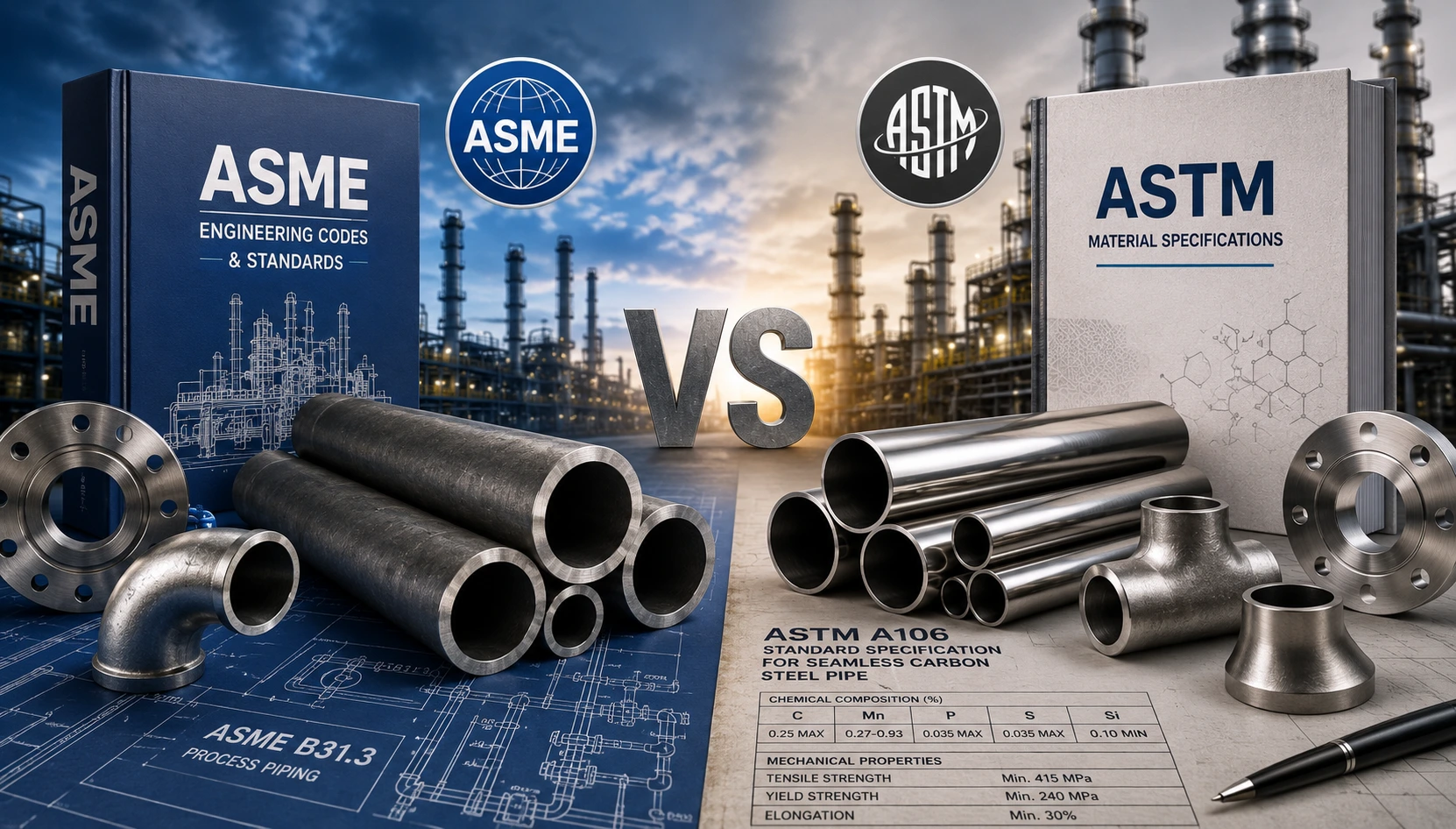
One of the most common sources of confusion when reading pipe specifications is seeing ASTM, ASME, and API together. Because ASTM and ASME address different aspects of industrial piping, understanding how ASME and ASTM standards complement each other can help engineers interpret technical specifications correctly.
They do not all perform the same function.
ASTM Standards
ASTM International develops material and product specifications along with test methods and related standards.
Examples commonly encountered in steel piping include:
- ASTM A106
- ASTM A53
- ASTM A312
- ASTM A234
These specifications can define requirements related to:
- Chemical composition
- Mechanical properties
- Manufacturing
- Heat treatment
- Testing
- Inspection
- Acceptance criteria
ASME Standards
ASME (American Society of Mechanical Engineers) develops engineering codes and standards covering areas such as piping design, dimensions, pressure equipment, flanges, and other mechanical engineering applications.
Examples relevant to piping include:
- ASME B31.3
- ASME B36.10
- ASME B36.19
- ASME B16.5
For example, ASME B36.10 deals with pipe dimensions, while ASME B31.3 provides requirements for process piping design and construction.
So when reading a specification, an ASME reference does not automatically mean that ASME is the material grade.
API Standards
API (American Petroleum Institute) develops standards widely used in the oil and natural gas industry.
One of the most important pipe-related specifications is:
API 5L – Line Pipe
API 5L covers line pipe used in pipeline transportation systems for the petroleum and natural gas industries.
API specifications may include designations such as:
- Grade B
- X42
- X52
- X60
- X65
- X70
Depending on the applicable product specification level and project requirements, additional requirements may apply to manufacturing, testing, documentation, and inspection.
ASME vs ASTM vs API: Quick Comparison
Organization | Main Focus | Example | Typical Application |
ASTM | Material & product specifications | ASTM A106 | Carbon steel pipe |
ASME | Engineering codes & dimensional standards | ASME B36.10 | Pipe dimensions / piping systems |
API | Oil & gas industry standards | API 5L | Line pipe |
Simple Way to Remember
ASTM → What the material/product must meet
ASME → How piping is designed or dimensioned
API → Petroleum and natural gas industry requirements
These roles can overlap in a project, but they should not be treated as interchangeable standards.
How to Read a Steel Pipe Specification: Practical Example
Now let’s break down a realistic specification:
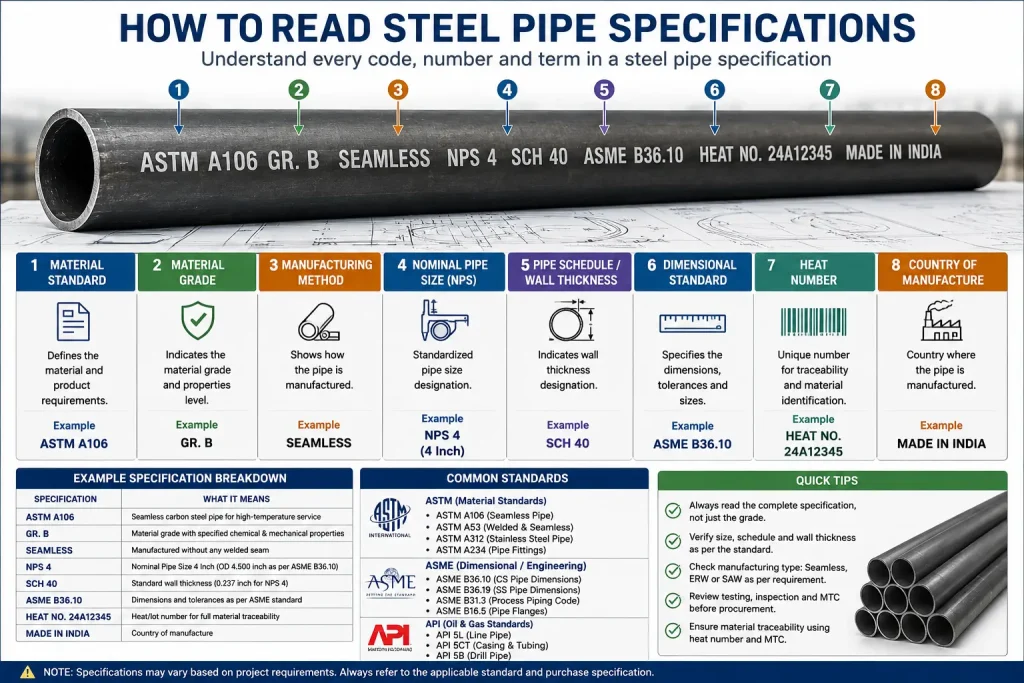
ASTM A106 Grade B, Seamless, NPS 4, SCH 40, ASME B36.10
Each part tells us something different.
What does the complete specification tell us?
It tells the buyer that the required product is a seamless carbon steel pipe meeting ASTM A106 Grade B requirements, with a 4-inch nominal pipe size, Schedule 40 wall thickness, and dimensions based on ASME B36.10.
This is much more precise than simply ordering a “4-inch carbon steel pipe.”
Why Reading the Complete Specification Matters
Two pipes can have the same nominal size but be completely different products.
For example:
NPS 4, SCH 40
does not tell you:
- Material
- Grade
- Manufacturing method
- Applicable product specification
- Testing requirements
A complete specification provides the information needed to determine whether the pipe is actually suitable for the intended application.
This becomes especially important for oil & gas, petrochemical, power generation, chemical processing, and other industrial projects where material traceability and specification compliance are critical.
How to Read Steel Pipe Specifications (ASTM, ASME & API Guide)
How to Identify a Steel Pipe Grade
The pipe grade is one of the most important parts of a steel pipe specification because it indicates the required material properties within a particular standard.
For example, a specification may identify:
- ASTM A106 Grade B
- ASTM A53 Grade B
- API 5L Grade B
- API 5L X42
- API 5L X52
- API 5L X65
The grade should never be interpreted separately from its governing specification.
For example, Grade B in ASTM A106 and Grade B in API 5L do not automatically mean that the two pipes are identical. The complete standard, manufacturing requirements, chemical composition, mechanical properties, testing, and intended application must all be considered.
When purchasing steel pipes, always verify the standard + grade + manufacturing method, rather than relying on the grade designation alone.
Understanding API 5L Pipe Specifications
API 5L is particularly important when dealing with line pipe for oil and natural gas transportation.
A specification might look like:
API 5L PSL2 X52, Seamless, NPS 6, SCH 40
Let’s break it down.
Specification | Meaning |
API 5L | Line pipe specification |
PSL2 | Product Specification Level 2 |
X52 | Pipe grade |
Seamless | Manufacturing method |
NPS 6 | Nominal pipe size |
SCH 40 | Wall thickness designation |
The important point is that PSL2 is not a pipe grade. It identifies a higher product specification level with additional or more stringent requirements compared with PSL1.
The exact requirements applicable to a pipe should always be verified against the current edition of the relevant specification and the project purchase specification.
Understanding Pipe End Types
Pipe specifications may also identify how the ends of the pipe need to be prepared.
Common pipe end configurations include:
Plain End
A plain-end pipe has a relatively square-cut end and is commonly used where the pipe will be prepared or connected according to the installation requirements.
Bevelled End
A bevelled end is prepared at an angle to facilitate welding.
Bevelled ends are commonly associated with butt-welded piping connections.
Threaded End
Threaded pipes have threads machined into the pipe ends so that they can connect to threaded fittings or other components.
This configuration is typically used for applications where threaded connections are appropriate.
Coupled End
Some pipe products may be supplied with couplings, particularly where the applicable product specification or application requires them.
The required end configuration should always be checked against the project specification before ordering.
Understanding Pipe Testing and Inspection Requirements
A steel pipe specification does more than define the material and dimensions. It may also establish requirements for testing and inspection.
Depending on the applicable standard and project requirements, these can include:
- Chemical analysis
- Tensile testing
- Yield strength testing
- Hardness testing
- Hydrostatic testing
- Dimensional inspection
- Visual inspection
- Non-destructive testing
- Heat treatment verification
- Surface examination
Not every pipe specification requires every test. The exact requirements depend on the applicable standard, grade, product specification level, purchase order, and project requirements.
What Is a Mill Test Certificate (MTC)?
A Mill Test Certificate (MTC) is a material document provided with steel products to demonstrate compliance with specified material requirements.
An MTC can contain information such as:
- Manufacturer
- Product description
- Material specification
- Grade
- Heat number
- Chemical composition
- Mechanical test results
- Dimensions
- Heat treatment information
- Testing results
- Applicable standards
The heat number is particularly important for material traceability because it allows the supplied product to be connected to its manufacturing and testing records.
For critical industrial projects, procurement and QA/QC teams should verify the documentation against the actual material markings and purchase specification.
Why Material Traceability Matters
Material traceability helps ensure that the steel pipe delivered to a project is the same material that was manufactured and tested according to the specified requirements.
A typical traceability process may involve:
Purchase Specification → Manufacturer → Heat Number → Test Certificate → Pipe Marking → Project Documentation
This becomes especially important in:
- Oil & gas
- Petrochemical
- Power generation
- Chemical processing
- EPC projects
- Critical process piping
Proper documentation can help identify the material’s origin, grade, test results, and compliance status.
Common Mistakes When Reading Steel Pipe Specifications
Even experienced buyers can encounter problems when specifications contain multiple standards and designations.
1. Confusing the Standard With the Grade
ASTM A106 is the specification, while Grade B is the grade within that specification.
They are not interchangeable.
2. Assuming NPS Equals Outside Diameter
NPS is a nominal designation.
For example:
NPS 4 ≠ 4.000-inch OD
An NPS 4 pipe has an outside diameter of approximately 4.500 inches (114.3 mm).
Always verify the dimensional standard before ordering.
3. Ignoring Pipe Schedule
Specifying only:
4-inch steel pipe
is incomplete for many industrial procurement requirements.
The specification may also need to identify the required:
- Schedule
- Wall thickness
- Standard
- Grade
- Manufacturing method
4. Treating ASTM, ASME and API as the Same Thing
These organizations and standards serve different purposes.
A project may use an ASTM material specification together with an ASME dimensional or design standard, while API requirements may apply where the product is intended for oil and gas pipeline service.
5. Assuming All Grade B Pipes Are Equivalent
The same grade designation can appear in different standards, but that does not make the materials identical.
Always read the complete specification, not just the grade.
6. Ignoring the Manufacturing Method
Seamless, ERW, and SAW pipes have different manufacturing processes and may have different applicable requirements.
The project specification should determine which manufacturing method is acceptable.
7. Not Checking the MTC
Material certification should be reviewed against the purchase order and specified standard.
Important information to verify includes:
- Grade
- Heat number
- Chemical composition
- Mechanical properties
- Dimensions
- Testing
- Manufacturer
8. Selecting Pipe Based Only on Price
A cheaper pipe may not meet the required standard, grade, schedule, testing, or documentation requirements.
For industrial projects, technical compliance should come before price comparison.
How to Select the Correct Steel Pipe
For industrial projects, working with a reliable Steel Pipe Supplier UAE can help procurement teams source pipes that meet the required material, dimensional, testing, and documentation specifications.
Before ordering a steel pipe, engineers and procurement teams should work through a structured checklist.
Step 1: Identify the Application
Determine whether the pipe is intended for:
- Process piping
- Oil & gas transportation
- Steam
- Water
- Chemical service
- Structural use
- Other industrial applications
Step 2: Determine Operating Conditions
Establish:
- Operating pressure
- Design pressure
- Operating temperature
- Design temperature
- Fluid characteristics
- Corrosion considerations
Step 3: Select the Material
Choose the appropriate material family, such as:
- Carbon steel
- Stainless steel
- Alloy steel
Step 4: Identify the Applicable Standard
Determine whether the project requires a specification such as:
- ASTM A106
- ASTM A53
- ASTM A312
- API 5L
The applicable engineering and dimensional standards should also be identified.
Step 5: Select the Grade
Examples include:
- ASTM A106 Grade B
- ASTM A53 Grade B
- API 5L X52
- API 5L X65
Step 6: Select the Manufacturing Method
Confirm whether the project requires:
- Seamless
- ERW
- SAW
- Other specified manufacturing processes
Step 7: Select Size and Wall Thickness
Specify:
- NPS
- Schedule
- Wall thickness
- Length
Step 8: Confirm End Preparation
Check whether the project requires:
- Plain ends
- Bevelled ends
- Threaded ends
- Coupled ends
Step 9: Verify Testing and Documentation
Confirm:
- Required testing
- Inspection requirements
- MTC
- Material traceability
- Applicable certifications
Steel Pipe Specification Checklist
Before placing a purchase order, use this quick checklist:
Specification Element | What to Verify |
Standard | ASTM / API / Other |
Grade | Required material grade |
Manufacturing | Seamless / ERW / SAW |
NPS | Nominal pipe size |
Schedule | Wall thickness designation |
OD | Actual outside diameter |
Length | Required pipe length |
Ends | Plain / bevelled / threaded / coupled |
Testing | Required inspections and tests |
Documentation | MTC and traceability |
Dimensional Standard | Applicable ASME or other standard |
This helps reduce specification errors during procurement and material inspection.
Conclusion
Reading a steel pipe specification becomes much easier when the information is separated into its individual components. The material standard identifies the applicable product requirements, the grade identifies the material level, the manufacturing method describes how the pipe was produced, and NPS, schedule, and dimensional standards define its physical dimensions.
ASTM, ASME, and API references can appear together in the same project because they address different aspects of industrial piping. A complete specification may therefore combine a material specification such as ASTM A106, a dimensional reference such as ASME B36.10, and project-specific engineering requirements.
Before purchasing any steel pipe, always verify the standard, grade, manufacturing method, size, schedule, end preparation, testing requirements, and material documentation. This systematic approach helps engineers and procurement teams obtain the correct pipe and maintain traceability throughout the project.
Frequently Asked Questions
Q1. What is a steel pipe specification?
Ans – A steel pipe specification is a set of technical requirements defining the pipe’s material, grade, manufacturing method, dimensions, testing, inspection, and documentation requirements.
Q2. How do you read a steel pipe specification?
Ans – Start by identifying the applicable standard, then check the material grade, manufacturing method, NPS, schedule or wall thickness, dimensional standard, end type, testing requirements, and certification documents.
Q3. What does ASTM mean on a steel pipe?
Ans – ASTM indicates that the pipe is manufactured or tested according to a relevant ASTM material or product specification. The specific ASTM designation, such as ASTM A106, identifies the applicable technical requirements.
Q4. What does ASME mean in pipe specifications?
Ans – ASME references can identify engineering codes or dimensional standards used in piping. For example, ASME B36.10 provides dimensional requirements for welded and seamless wrought steel pipes.
Q5. What does API mean on steel pipe?
Ans – API refers to standards developed by the American Petroleum Institute. API 5L, for example, is a widely used specification for line pipe in petroleum and natural gas transportation applications.
Q6. How do I identify a steel pipe grade?
Ans – The grade is normally stated alongside the applicable material specification, such as ASTM A106 Grade B or API 5L X52. The complete specification should be verified rather than relying on the grade designation alone.
Q7. What does SCH 40 mean on a pipe?
Ans – SCH 40, or Schedule 40, is a standardized wall-thickness designation. The actual wall thickness depends on the nominal pipe size, so SCH 40 does not represent one universal thickness for every pipe size.
Q8. What does NPS mean in pipe specifications?
Ans – NPS stands for Nominal Pipe Size. It is a standardized designation used to identify pipe size and does not always equal the actual outside diameter.
Q9. What is PSL2 in API 5L?
Ans – PSL2 stands for Product Specification Level 2. It establishes additional or more stringent requirements compared with PSL1 under the applicable API 5L requirements.
Q10. What is the difference between seamless and welded pipe?
Ans – Seamless pipe is manufactured without a longitudinal welded seam, while welded pipe is produced by forming steel and joining the edges through a welding process. The appropriate type depends on the applicable specification and project requirements.
Q11. What documents should be checked when buying steel pipes?
Ans – Buyers should review the purchase specification, manufacturer documentation, Mill Test Certificate (MTC), material grade, heat number, chemical and mechanical test results, dimensions, testing records, and required certifications.
Q12. Is ASTM A106 the same as ASME B36.10?
Ans – No. ASTM A106 is a material/product specification for seamless carbon steel pipe, while ASME B36.10 addresses dimensions of welded and seamless wrought steel pipes. They can be referenced together because they govern different aspects of the product.
Q13. Can one steel pipe have both ASTM and ASME specifications?
Ans – Yes. A steel pipe can meet an ASTM material specification while its dimensions are specified according to an ASME dimensional standard. This combination is common in industrial piping specifications.