A Complete Guide to Weld Neck, Slip-On, Blind, Socket Weld, Threaded and Lap Joint Flanges
Pipe flanges are essential components in industrial piping systems because they provide a secure and serviceable method of connecting pipes with valves, equipment, fittings, and other piping components. Unlike permanent welded connections, flanged connections can be dismantled when inspection, maintenance, replacement, or modification is required.
Different flange designs are available because piping systems operate under different pressure, temperature, flow, installation, and maintenance conditions. Weld neck, slip-on, blind, socket weld, threaded, and lap joint flanges each have specific characteristics that make them suitable for particular applications.
Choosing the right flange is therefore not simply a matter of matching the pipe size. Engineers and procurement teams must also consider operating pressure, temperature, material, pipe dimensions, connection method, flange facing, and applicable standards.
This guide explains the main types of pipe flanges, how each type works, where it is commonly used, and what factors should be considered when selecting a flange for an industrial piping system.
What Are the Main Types of Pipe Flanges?
The main types of pipe flanges used in industrial piping include weld neck, slip-on, blind, socket weld, threaded, and lap joint flanges. Weld neck flanges are commonly selected for high-pressure and high-temperature services, while slip-on flanges offer simpler installation for general industrial applications. Blind flanges are used to close pipe ends, socket weld flanges are suitable for smaller-bore piping, threaded flanges provide connections without welding, and lap joint flanges are useful where frequent dismantling or maintenance is required.
What Is a Pipe Flange?
A pipe flange is a mechanical component used to create a bolted connection between pipes, valves, pumps, pressure equipment, and other piping components.
Flanges are commonly installed with steel piping systems, so sourcing compatible components from a reliable Steel Pipe Supplier UAE can simplify material procurement for industrial projects.
A typical flanged connection consists of:
- Two mating flanges
- Bolts and nuts
- A gasket
- The connected pipe or equipment
The gasket is positioned between the flange faces to help create a leak-resistant joint when the connection is properly assembled and tightened.
Flanged connections are particularly valuable in industrial systems because they can be disassembled without cutting the pipe. This makes inspection, maintenance, equipment replacement, and future modifications easier.
Standardized flange dimensions also allow compatible components to be sourced from different manufacturers. For example, ASME B16.5 specifies dimensions, tolerances, pressure-temperature ratings, materials, marking, and testing requirements for covered pipe flanges and flanged fittings.
Why Are Flanges Used in Industrial Piping?
Flanges are used when a piping system requires a reliable connection that can also be disconnected when necessary.
Flanged connections are often installed alongside valves and other piping components, making it important to source compatible products from a reliable pipe fittings supplier.
Easy Maintenance
One of the biggest advantages of a flanged connection is its ability to be dismantled. Engineers can remove valves, pumps, strainers, or other equipment without cutting the pipeline.
This is particularly useful in facilities where regular inspection and maintenance are required.
Connecting Pipes to Equipment
Flanges provide a practical connection between piping and equipment such as:
- Pumps
- Valves
- Heat exchangers
- Pressure vessels
- Tanks
- Filters
- Compressors
Pipeline Isolation
Blind flanges can be installed to close sections of piping during maintenance, testing, future expansion, or equipment isolation.
Standardized Connections
Standardized flange dimensions make it easier to match piping components according to:
- Nominal pipe size
- Pressure class
- Material
- Facing
- Bolt pattern
This standardization is particularly important for large industrial projects involving multiple suppliers and contractors.
Types of Pipe Flanges
The most commonly encountered flange designs in industrial piping include:
- Weld Neck Flanges
- Slip-On Flanges
- Blind Flanges
- Socket Weld Flanges
- Threaded Flanges
- Lap Joint Flanges
Each design has a different connection method and is selected according to the requirements of the piping system.
1. Weld Neck Flanges
A weld neck flange has a long tapered hub that connects to the pipe through a butt weld. Its geometry provides a gradual transition from the flange to the pipe, making it well suited to demanding piping services.
Weld neck flanges are frequently considered for systems where pressure, temperature, cyclic loading, or mechanical stresses are significant.
Key Advantages
- High structural strength
- Good resistance to bending stresses
- Suitable for high-pressure services
- Suitable for high-temperature applications
- Strong butt-welded connection
- Good fatigue resistance when properly designed and welded
Common Applications
Weld neck flanges are commonly used in:
- Oil & gas facilities
- Refineries
- Petrochemical plants
- Power generation
- Chemical processing
- High-pressure process piping
For critical piping systems, engineers typically select the flange design based on the complete operating conditions rather than flange type alone.
2. Slip-On Flanges
A slip-on flange is designed to slide over the outside of the pipe before being welded into position.
Because the pipe fits inside the flange, alignment and installation can be relatively straightforward compared with some other flange designs.
Key Advantages
- Relatively simple installation
- Easy pipe alignment
- Suitable for many general industrial applications
- Often economical for suitable services
- Available in a wide range of standard sizes and pressure classes
Common Applications
Slip-on flanges may be used in:
- General process piping
- Water systems
- Utility piping
- Low-to-moderate pressure services
- Industrial manufacturing facilities
For higher-demand applications, the suitability of a slip-on flange should be evaluated against the project’s design code, pressure, temperature, material, and loading requirements.
3. Blind Flanges
A blind flange is a solid flange without a central bore. Its primary purpose is to close the end of a pipe, nozzle, valve, or piping section.
Because it completely blocks the opening, a blind flange can be used when a pipeline section needs to be isolated or when a connection may be required for future expansion.
Key Advantages
- Completely closes a piping opening
- Useful for isolation
- Can be removed for future pipeline extension
- Facilitates maintenance access to certain equipment connections
- Suitable for pressure-containing applications when correctly specified
Common Applications
Blind flanges are commonly found in:
- Oil & gas pipelines
- Refineries
- Petrochemical plants
- Pressure vessels
- Process plants
- Pipeline isolation points
- Maintenance sections
A blind flange should always be selected according to the required pressure-temperature conditions and applicable specifications.
4. Socket Weld Flanges
A socket weld flange has a recessed area, or socket, into which the pipe is inserted before being welded.
This configuration is commonly used for smaller-diameter piping, particularly where a compact and strong connection is required.
Key Advantages
- Suitable for small-bore piping
- Compact connection design
- Good strength for appropriate applications
- Internal pipe alignment can be controlled during installation
- Does not require the pipe to pass through the flange like a slip-on configuration
Common Applications
Socket weld flanges can be used in:
- Instrumentation piping
- Chemical processing
- High-pressure utility systems
- Small-diameter process lines
- Industrial equipment connections
The correct flange design should be determined from the applicable project specifications and piping code.
5. Threaded Flanges
A threaded flange uses internal threads to connect with a threaded pipe. This means the connection can be made without welding the flange directly to the pipe.
This can make threaded flanges useful in applications where welding is undesirable or difficult.
Key Advantages
- No flange-to-pipe welding required
- Relatively simple installation
- Useful where welding facilities are limited
- Suitable for certain utility and service applications
Common Applications
Threaded flanges may be considered for:
- Utility piping
- Instrumentation services
- Certain low-to-moderate pressure systems
- Applications where welding is restricted
However, threaded connections require careful consideration of pressure, temperature, vibration, and leakage risks before selection.
6. Lap Joint Flanges
A lap joint flange is used together with a separate stub end. Unlike a weld neck or slip-on flange, the flange itself is not welded directly to the pipe.
The stub end is welded to the pipe, while the lap joint flange can rotate around it. This makes alignment easier during assembly.
Key Advantages
- Easy alignment
- Useful where frequent dismantling is required
- Flange can rotate for easier bolt-hole alignment
- Can be useful with certain corrosion-resistant piping materials
- Potentially reduces replacement cost when suitable materials are used
Common Applications
Lap joint flanges are often considered for:
- Chemical processing
- Corrosive services
- Food processing
- Marine applications
- Piping systems requiring frequent maintenance
- Systems requiring regular dismantling
The suitability of a lap joint configuration depends on the piping design, operating conditions, materials, and applicable standards.
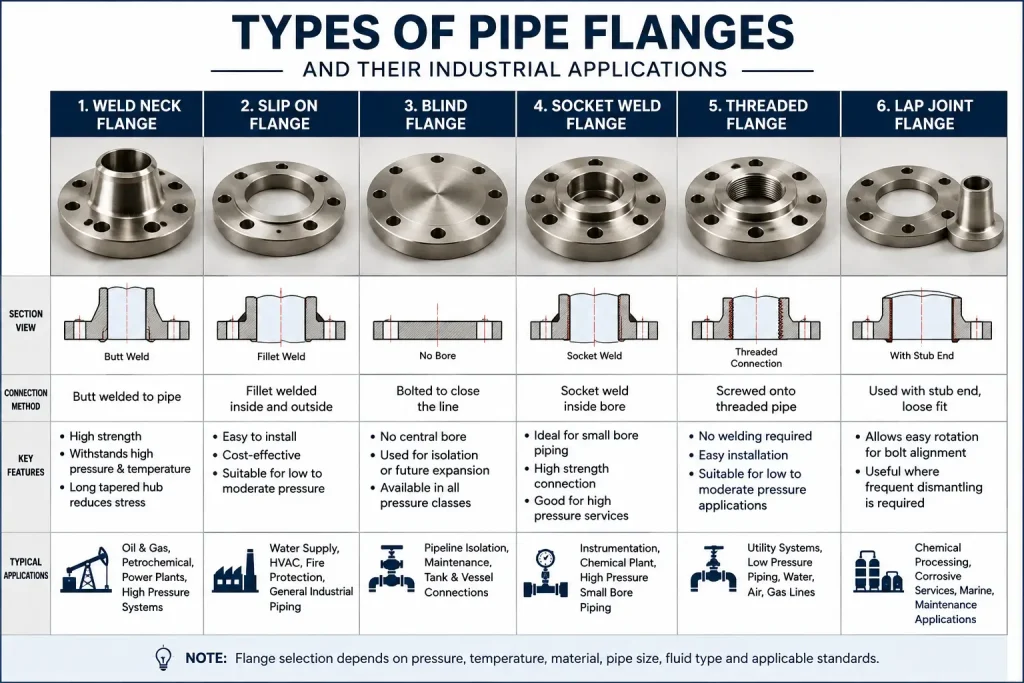
Pipe Flange Types Comparison
This table gives a quick overview of the major flange types and their typical applications.
Key Takeaway
There is no single “best” pipe flange for every application.
The correct choice depends on:
- Operating pressure
- Operating temperature
- Pipe size
- Pipe material
- Fluid being transported
- Mechanical loading
- Installation requirements
- Maintenance requirements
- Applicable engineering standards
ASME B16.5 covers several of these standard flange configurations for NPS ½ through NPS 24, while large-diameter steel flange requirements are covered separately by ASME B16.47 for NPS 26 through NPS 60.
How to Choose the Right Pipe Flange
Selecting the right flange requires more than matching the pipe diameter. Engineers need to evaluate the complete operating environment to ensure the connection remains safe, reliable, and serviceable throughout the piping system’s lifecycle.
The most important factors include pressure, temperature, pipe size, material, flange facing, connection type, and applicable standards.
Consider Operating Pressure
Operating pressure is one of the first factors to evaluate when selecting a flange.
A flange must be capable of handling the system’s design pressure under the expected operating conditions. Industrial flange specifications commonly include pressure-temperature ratings that help engineers determine whether a particular flange is suitable for the service.
For example, a flange used in a high-pressure process line may require a more robust design than one used in a low-pressure utility system.
However, pressure class alone should not be used to select a flange. Temperature and material also affect the allowable operating conditions.
Consider Operating Temperature
Temperature can significantly affect the performance of piping materials and flange connections.
High-temperature applications may require materials and flange configurations capable of maintaining their mechanical properties under elevated temperatures.
Typical high-temperature applications include:
- Steam systems
- Refineries
- Power generation
- Petrochemical processing
- High-temperature process lines
Engineers should always verify the applicable pressure-temperature rating rather than assuming that a flange is suitable simply because its nominal pressure class appears adequate.
Check Pipe Size
Flange dimensions must match the pipe size and connection requirements. Flange selection should also account for the pipe’s pipe schedule, since wall thickness and bore dimensions can affect the compatibility of the flange with the piping system.
Important dimensions include:
- Nominal Pipe Size (NPS)
- Outside diameter
- Flange thickness
- Bolt circle diameter
- Number of bolt holes
- Bolt-hole diameter
- Flange bore
Using an incorrect flange size can result in alignment problems, leakage, or installation delays.
This is particularly important when sourcing components from different manufacturers.
Select the Correct Material
The flange material must be compatible with the pipe material, transported fluid, operating temperature, and surrounding environment.
For carbon steel piping systems, coordinating flange specifications with experienced Carbon Steel Pipe Suppliers UAE can help ensure compatibility between the pipe and connected components.
Common industrial flange materials include:
Carbon Steel
Carbon steel flanges are widely used for general industrial services, oil & gas, petrochemical, and process piping.
Stainless Steel
Stainless steel flanges are preferred where corrosion resistance is important, including chemical, marine, food processing, and water treatment applications.
Alloy Steel
Alloy steel may be selected for demanding temperature, pressure, or mechanical service conditions.
Material specifications should always be verified against the project’s requirements and applicable standards.
Flange Facing Types
The flange facing is the surface that contacts the gasket and forms part of the sealing system.
Common facing configurations include:
- Raised Face (RF)
- Flat Face (FF)
- Ring Type Joint (RTJ)
Raised Face
Raised face flanges have a raised sealing surface around the bore. They are widely used in industrial piping applications and provide a defined area for gasket compression.
Flat Face
Flat face flanges have a flat sealing surface and are commonly selected for certain lower-pressure or equipment connection applications where compatibility with mating components is required.
Ring Type Joint
RTJ flanges use a specially machined groove and metal ring gasket to create a high-integrity seal.
They are commonly associated with demanding high-pressure and high-temperature services.
The mating flange and gasket configuration must always be compatible.
Where corrosion resistance is important, engineers can coordinate stainless steel piping and flange requirements with reliable SS Pipes & Fittings Suppliers UAE.
How Flange Type and Facing Work Together
Flange selection is not simply about choosing a weld neck, slip-on, or blind flange.
Engineers must consider the complete connection, including:
Flange type + pressure class + material + facing + gasket + bolts
For example, selecting a weld neck flange with the wrong facing or incompatible gasket can compromise the overall connection even if the flange itself is suitable.
This is why industrial piping procurement should be based on the complete project specification rather than flange type alone.
Industrial Applications of Pipe Flanges
Pipe flanges are used across a wide range of industries because they provide standardized and serviceable connections between piping components.
Oil & Gas
Oil & gas facilities use flanges throughout gathering, processing, transmission, and storage systems.
Common applications include:
- Process piping
- Pipeline connections
- Valve connections
- Pump connections
- Pressure equipment
- Isolation points
Weld neck and blind flanges are particularly relevant in demanding piping systems where pressure containment and isolation are important.
Petrochemical Plants
Petrochemical facilities operate with complex networks of process piping carrying hydrocarbons and chemicals.
Flanges may be used to connect:
- Reactors
- Pumps
- Heat exchangers
- Valves
- Process lines
- Storage systems
The flange configuration is selected according to pressure, temperature, chemical compatibility, and maintenance requirements.
Refineries
Refineries contain extensive piping networks operating across different pressure and temperature ranges.
Flanged connections are commonly used around:
- Process equipment
- Heat exchangers
- Pumps
- Valves
- Steam systems
- Hydrocarbon lines
High-integrity flange connections are particularly important where leakage could create safety or environmental risks.
Power Generation
Power plants use flanged connections throughout steam, cooling water, condensate, and auxiliary systems.
Applications can include:
- Steam piping
- Boiler connections
- Cooling systems
- Feedwater systems
- Pumps
- Valves
The selected flange must be appropriate for the operating pressure and temperature of the specific service.
Chemical Processing
Chemical plants may transport aggressive or corrosive fluids through extensive piping networks.
Flange selection therefore needs to consider:
- Chemical compatibility
- Corrosion resistance
- Temperature
- Pressure
- Maintenance requirements
Stainless steel and other corrosion-resistant materials may be selected where required by the process conditions.
Water Treatment
Water treatment facilities use flanges to connect pumps, valves, filtration equipment, pipelines, and treatment systems.
Depending on the application, engineers may use different flange types and materials to meet pressure, corrosion, and maintenance requirements.
Marine and Offshore Applications
Marine and offshore facilities require piping systems that can withstand challenging operating environments.
Flanges may be used in:
- Seawater systems
- Firefighting systems
- Fuel systems
- Cooling systems
- Ballast systems
- Utility piping
Material selection and corrosion resistance become particularly important in marine environments.
Common Flange Selection Mistakes
Even when the correct flange type is known, several specification mistakes can create problems during installation. Understanding ANSI vs ASME flanges can also help procurement teams distinguish between commonly used terminology and the applicable dimensional and pressure-rating standards.
Choosing Only by Pipe Size
Matching the NPS is necessary, but it is not sufficient.
Pressure class, material, facing, bore, and connection method must also be checked.
Ignoring Temperature
A flange suitable at ambient temperature may have different allowable pressure at elevated temperatures.
Always verify the applicable pressure-temperature rating.
Using an Incompatible Facing
Mating flange faces and gasket configurations must be compatible.
Incorrect combinations can lead to sealing problems.
Ignoring Material Compatibility
The flange material should be suitable for the pipe, fluid, temperature, and surrounding environment.
Selecting the Cheapest Option
The lowest initial price does not necessarily provide the best long-term value.
A flange should be selected based on technical suitability, quality, certification, and lifecycle requirements.
Not Checking Standards
Before procurement, verify the applicable flange standard, dimensional requirements, material specification, and project-specific requirements.
For standard industrial flange applications, ASME B16.5 and ASME B16.47 are important dimensional and rating references depending on the applicable size range.
Best Practices for Flange Selection
A reliable flange selection process should include:
- Determine the pipe size.
- Identify the design pressure.
- Identify the design temperature.
- Determine the transported fluid.
- Select a compatible material.
- Select the appropriate flange type.
- Confirm the flange facing.
- Verify gasket and bolting compatibility.
- Check applicable standards.
- Confirm certification and traceability before installation.
This systematic approach helps reduce procurement errors and improves the reliability of industrial piping connections.
Conclusion
The different types of pipe flanges exist because industrial piping systems have different pressure, temperature, connection, maintenance, and material requirements.
Weld neck flanges are commonly considered for demanding high-pressure and high-temperature services, while slip-on flanges provide a practical option for many general industrial applications. Blind flanges are used to close piping openings, socket weld flanges are useful for suitable small-bore services, threaded flanges provide non-welded connections in appropriate applications, and lap joint flanges offer flexibility where frequent dismantling or alignment is important.
Choosing the correct flange requires consideration of more than just the flange type. Engineers should evaluate pipe size, pressure, temperature, material, facing, gasket, bolting, applicable standards, and service conditions before finalizing the specification.
A properly selected and installed flange connection can improve system reliability, simplify maintenance, and help maintain safe operation across demanding industrial piping applications.
Frequently Asked Questions
Q1. What are the main types of pipe flanges?
The main types include weld neck, slip-on, blind, socket weld, threaded, and lap joint flanges. Each type has different connection characteristics and is suited to specific piping applications.
Q2. What is a weld neck flange used for?
Weld neck flanges are commonly used in demanding piping applications involving high pressure, high temperature, cyclic loading, or significant mechanical stresses. They are frequently found in oil & gas, petrochemical, refinery, and power-generation systems.
Q3. What is a slip-on flange used for?
Slip-on flanges are used in many general industrial and utility piping applications where relatively simple installation and alignment are beneficial. Their suitability depends on the system’s design conditions and applicable code.
Q4. When should a blind flange be used?
Blind flanges are used to close the end of a pipe, nozzle, or piping section. They are useful for isolation, maintenance, pressure-containing closures, and future pipeline expansion.
Q5. What is a socket weld flange used for?
Socket weld flanges are commonly used for suitable small-bore piping applications where a compact welded connection is required.
Q6. What is the difference between a weld neck and slip-on flange?
A weld neck flange connects to the pipe through a butt weld and has a tapered hub, while a slip-on flange fits over the pipe and is welded into position. Weld neck designs are generally preferred for more demanding services where their structural characteristics are beneficial.
Q7. Which flange is best for high-pressure applications?
There is no single flange that is best for every high-pressure application. Weld neck and other specialized flange configurations may be selected depending on pressure, temperature, pipe size, material, loading, and the applicable piping code.
Q8. What standards are used for industrial pipe flanges?
Common standards include ASME B16.5 for many pipe flanges and flanged fittings and ASME B16.47 for large-diameter steel flanges. The applicable material specification may come from ASTM or another recognized material standard.
Q9. How do you select the right flange for a piping system?
Evaluate pipe size, pressure, temperature, fluid, material compatibility, flange facing, gasket, bolting, connection method, applicable standards, and maintenance requirements before selecting the flange.
Q10. Can stainless steel and carbon steel flanges be used together?
They can be used together in some engineered applications, but compatibility, galvanic corrosion, temperature, pressure, gasket selection, bolting, and project specifications must be evaluated before installation.
Q11. Why are flanges used instead of welded connections?
Flanges provide a removable connection, making it easier to inspect, maintain, replace, or modify piping components such as valves and equipment without cutting the pipeline.