When sourcing industrial flanges, terms such as ANSI flanges, ASME flanges, and ASME B16.5 flanges are often used interchangeably. This can create confusion for engineers, procurement teams, contractors, and project managers trying to select the correct flange for a piping system.
The important point is that ANSI and ASME are not simply two competing organizations that manufacture different types of flanges. ANSI is the American National Standards Institute, which coordinates the U.S. voluntary standards system and approves American National Standards developed through accredited standards developers. ASME, meanwhile, develops engineering codes and standards, including ASME B16.5 for pipe flanges and flanged fittings.
In industrial piping, the term “ANSI flange” is commonly used as a legacy or industry shorthand for flanges manufactured according to the dimensional and pressure requirements historically associated with ANSI B16.5. Today, the applicable standard is referred to as ASME B16.5.
Understanding this distinction is important when purchasing flanges for oil & gas, petrochemical, EPC, power generation, marine, and other industrial applications.
For industrial projects, working with an experienced Pipe Supplier UAE can help ensure that the selected pipes, flanges, and fittings meet the required project specifications.
What Are ANSI Flanges?
The term ANSI flange is commonly used in the piping industry to describe flanges associated with the American National Standards Institute’s historical designation of flange standards.
However, ANSI itself does not develop standards. ANSI accredits standards developers and approves documents as American National Standards when the required consensus and due-process requirements are satisfied.
This is why you may still encounter specifications, product listings, drawings, and supplier catalogs that refer to:
- ANSI flanges
- ANSI B16.5 flanges
- ANSI 150 flanges
- ANSI 300 flanges
- ANSI 600 flanges
In many cases, these terms are referring to the flange dimensions and pressure classes covered by what is now ASME B16.5.
Flanges are commonly used alongside steel piping systems, making it important to source compatible components from a reliable Steel Pipe Supplier UAE
What Are ASME Flanges?
ASME flanges are flanges manufactured or specified according to applicable ASME standards.
For common industrial pipe flanges and flanged fittings from NPS 1/2 through NPS 24, the relevant standard is ASME B16.5. The current ASME B16.5 edition covers pressure-temperature ratings, materials, dimensions, tolerances, marking, testing, and methods of designating openings.
ASME B16.5 covers flange rating classes including:
- Class 150
- Class 300
- Class 400
- Class 600
- Class 900
- Class 1500
- Class 2500
The Class 2500 flange designation is covered for sizes NPS 1/2 through NPS 12, while the other listed flange classes extend through NPS 24 under the standard.
ANSI vs ASME Flanges: What’s the Difference?
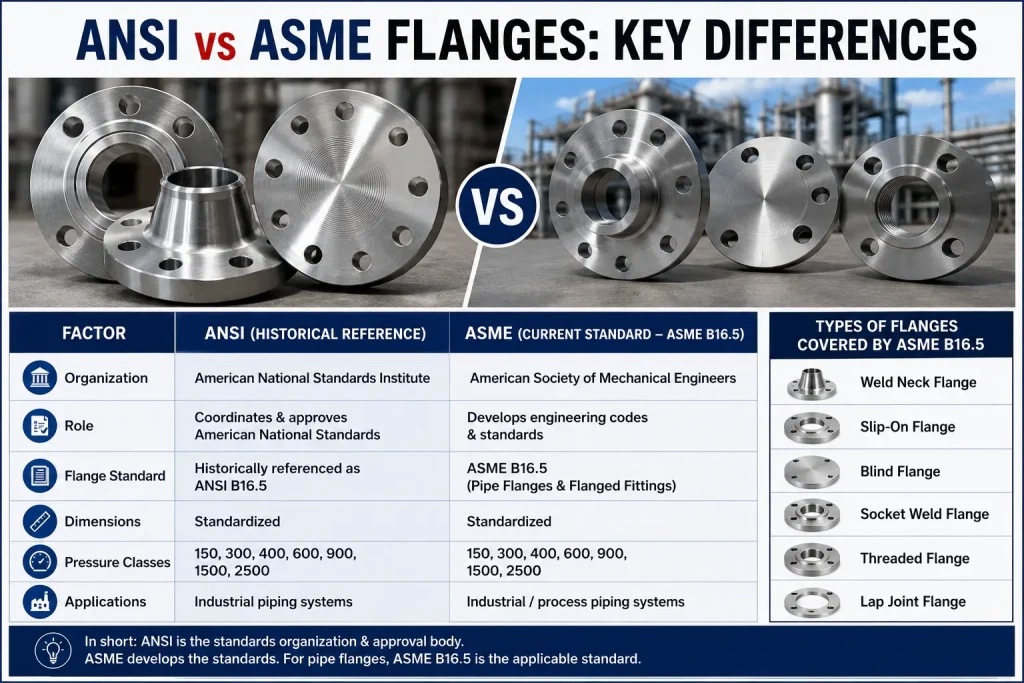
The biggest misconception is that an ANSI flange and an ASME flange necessarily represent two different physical products.
In modern specifications, ASME B16.5 is the relevant standard for the common pipe flanges and flanged fittings covered by that document. The term “ANSI flange” is still widely used in industry because of historical naming conventions.
Flanges form an important part of complete piping assemblies, and reliable Pipe Fittings Suppliers in UAE can provide compatible fittings and connection components for industrial systems.
So, if a project specification asks for an ANSI Class 300 flange, it is important to confirm the applicable standard and edition rather than assuming ANSI and ASME are separate flange systems.
ANSI B16.5 vs ASME B16.5
This is where most of the confusion comes from.
Older documents and industry references may use the designation ANSI B16.5, while modern documentation generally refers to ASME B16.5.
Historical editions have appeared under ANSI/ASME designations as standards evolved. For example, the ANSI Standards Store records an ANSI/ASME B16.5-2003 edition, while subsequent editions are designated ASME B16.5.
The current ASME B16.5 standard covers:
- Pressure-temperature ratings
- Materials
- Dimensions
- Tolerances
- Marking
- Testing
- Opening designations
- Flange bolting
- Gaskets
- Flange joints
It covers pipe flanges and flanged fittings in metric and U.S. customary units.
In simple terms:
ANSI = standards organization and approval framework
ASME = engineering standards developer
ASME B16.5 = the applicable standard for many common industrial pipe flanges and flanged fittings
What Does ASME B16.5 Cover?
ASME B16.5 is specifically focused on pipe flanges and flanged fittings from NPS 1/2 through NPS 24. It establishes requirements that allow compatible components to be properly specified, manufactured, connected, and tested.
The standard addresses important flange characteristics such as:
Dimensions
Flange dimensions must conform to specified requirements so that compatible piping components can be properly assembled.
Pressure-Temperature Ratings
The standard provides pressure-temperature rating requirements for different flange classes and materials.
Materials
Material requirements are specified for the covered flange and flanged fitting products.
Tolerances
Manufacturing tolerances help maintain dimensional consistency.
Marking
Requirements are provided for identifying products appropriately.
Testing
Applicable testing requirements are included within the standard.
Flange Joints
ASME B16.5 also includes requirements and recommendations related to flange bolting, gaskets, and flange joints.
Types of Flanges Covered by Industrial Piping Specifications
Depending on the project and applicable standards, industrial piping systems may use several flange configurations.
Weld Neck Flanges
Weld neck flanges feature a long tapered hub and are commonly selected for high-pressure and high-temperature applications.
They are widely used in:
- Oil & gas
- Petrochemical plants
- Refineries
- Power generation
- Process piping
Slip-On Flanges
Slip-on flanges are installed over the pipe and welded in position. They are commonly used where installation simplicity and cost efficiency are important.
Blind Flanges
Blind flanges are used to close the end of a piping system, valve, nozzle, or vessel connection.
They are particularly useful when a section of the system needs to be isolated or future expansion is anticipated.
Socket Weld Flanges
Socket weld flanges are designed for smaller-diameter piping applications where the pipe is inserted into the flange socket and welded.
Threaded Flanges
Threaded flanges allow connections without welding and can be useful in specific piping applications where welding is undesirable or impractical.
Lap Joint Flanges
Lap joint flange assemblies are commonly used where frequent dismantling of the piping system is required.
Understanding Flange Pressure Classes
One of the most important considerations when selecting a flange is its pressure class.
Common ASME B16.5 flange classes include:
- Class 150
- Class 300
- Class 400
- Class 600
- Class 900
- Class 1500
- Class 2500
However, a higher class number should not simply be interpreted as a universal pressure value in psi for every material and temperature.
The actual allowable pressure depends on factors including:
- Material
- Operating temperature
- Flange class
- Applicable standard
- Project requirements
ASME B16.5 establishes pressure-temperature rating requirements for the covered flange classes and materials.
ANSI Class 150 vs ASME Class 150
You may encounter both ANSI Class 150 and ASME Class 150 in supplier catalogs and project documentation.
In modern industrial usage, these terms often refer to the same general flange class associated with the B16.5 dimensional standard.
However, procurement teams should always verify the complete specification rather than relying only on the word “ANSI.”
For example, a purchase specification should ideally identify:
- Applicable standard
- Flange type
- NPS size
- Pressure class
- Material grade
- Facing type
- Schedule/bore where applicable
- Manufacturing requirements
- Testing requirements
This avoids compatibility and specification problems during procurement.
ANSI Class 300 vs ASME Class 300
The same principle applies to Class 300.
An older supplier catalog may describe a product as an ANSI Class 300 flange, while a current engineering specification may identify it as an ASME B16.5 Class 300 flange.
The important consideration is not simply whether the supplier uses the word ANSI or ASME. The critical factor is whether the flange complies with the specified standard, dimensions, material, rating, and project requirements.
ANSI vs ASME Flange Dimensions
Flange compatibility depends heavily on standardized dimensions.
Important dimensional considerations include:
- Outside diameter
- Flange thickness
- Bolt circle diameter
- Number of bolt holes
- Bolt-hole diameter
- Bore diameter
- Facing dimensions
- Hub dimensions
- Overall flange configuration
ASME B16.5 establishes dimensional requirements and tolerances for covered flanges and flanged fittings.
This standardization allows compatible components from different manufacturers to be used within properly specified piping systems.
How to Choose the Right Flange
Choosing a flange should never be based solely on whether a supplier calls it an “ANSI flange” or an “ASME flange.”
Instead, evaluate the complete application.
1. Determine Pipe Size
Identify the nominal pipe size (NPS) required for the piping system.
2. Determine Pressure and Temperature
Operating pressure and temperature directly influence the appropriate flange rating.
3. Select the Material
The flange material must be compatible with:
- Operating environment
- Fluid
- Temperature
- Pressure
- Corrosion conditions
Common industrial materials include carbon steel, stainless steel, alloy steel, and other engineering materials.
4. Select the Flange Type
Choose the appropriate configuration based on the application:
- Weld Neck
- Slip-On
- Blind
- Socket Weld
- Threaded
- Lap Joint
5. Check the Facing
Flange facing selection is important for gasket compatibility and joint performance.
6. Verify the Applicable Standard
Always confirm whether the project requires:
- ASME B16.5
- Another ASME B16 standard
- A project-specific specification
- Another applicable international standard
For large-diameter flanges beyond the scope of B16.5, another standard may apply. For example, ASME B16.47 addresses large-diameter steel flanges from NPS 26 through NPS 60.
Applications of ASME Flanges
ASME-compliant flanges are widely used throughout industrial piping systems.
Oil & Gas
Flanges provide detachable connections between pipes, valves, equipment, and other components in oil and gas facilities.
Oil and gas piping systems often combine flanges with carbon steel piping, making reliable Carbon Steel Pipe Suppliers in UAE an important part of industrial procurement.
Petrochemical
Petrochemical facilities use flanged connections throughout process and utility piping systems.
Refineries
Refineries require reliable flange connections for process lines, equipment connections, valves, and maintenance access.
Power Generation
Flanges are used in various steam, water, fuel, and utility piping systems.
Chemical Processing
Material and flange selection becomes especially important when piping systems handle corrosive or chemically aggressive fluids.
EPC Projects
Engineering, procurement, and construction projects typically require detailed flange specifications based on project codes, material requirements, pressure classes, and operating conditions.
EPC piping systems may also require specialized branch connection components such as weldolets, which can be sourced from experienced Weldolet Suppliers in UAE
Why Choose JSS Pipes for Industrial Flanges?
Selecting the correct flange is only one part of a successful piping project. The supplier must also understand the required specifications and provide products that match the project requirements.
JSS Pipes supplies industrial piping products for applications across the UAE and Middle East, supporting sectors such as:
- Oil & Gas
- Petrochemical
- EPC
- Power Generation
- Marine
- Infrastructure
- Industrial Manufacturing
Our product range includes pipe flanges, forged fittings, stainless steel fittings, carbon steel piping products, weldolets, and other industrial piping components.
For stainless steel piping applications, JSS Pipes also provides access to SS Fittings Suppliers in UAE solutions for industrial and process piping requirements.
For projects requiring specific flange dimensions, materials, pressure classes, or standards, our team can help identify suitable products based on the project specification.
ANSI vs ASME Flanges: Which One Should You Choose?
The terms ANSI flanges and ASME flanges can be confusing because both appear frequently in industrial piping specifications and supplier catalogs. The key distinction is that ANSI is the organization responsible for coordinating and approving American National Standards, while ASME develops engineering standards such as ASME B16.5.
For modern flange procurement, engineers and buyers should focus on the complete specification rather than the ANSI-versus-ASME terminology alone. Pipe size, pressure class, material, temperature, flange type, facing, and applicable standard all need to be verified before ordering.
For industrial projects in the UAE, working with an experienced piping supplier can help ensure that the selected flanges meet the required technical and project specifications.
Conclusion
Choosing between carbon steel vs stainless steel pipes depends on your operating environment, budget, maintenance expectations, and project specifications. Carbon steel remains an excellent choice for strength and affordability, while stainless steel provides superior corrosion resistance and long-term durability.
Before selecting a piping material, consider factors such as fluid type, temperature, pressure, environmental conditions, and lifecycle costs. Working with an experienced supplier ensures you receive the right products for your specific application.
Whether you need carbon steel pipes, stainless steel pipes, fittings, or complete industrial piping solutions, JSS Pipes is committed to delivering quality products that meet international standards and project requirements.
Frequently Asked Questions
Q1. Are ANSI and ASME flanges the same?
Ans – ANSI and ASME are not two competing flange manufacturers or identical organizations. ANSI coordinates and approves American National Standards, while ASME develops engineering standards such as ASME B16.5. The term “ANSI flange” is commonly used as legacy industry terminology for flanges associated with the historical ANSI B16.5 designation.
Q2. What is the difference between ANSI B16.5 and ASME B16.5?
Ans – ANSI B16.5 is an older/legacy designation found in historical references. Modern specifications generally use ASME B16.5 for the standard covering pipe flanges and flanged fittings from NPS 1/2 through NPS 24.
Q3. Is ANSI B16.5 still used?
Ans – The term “ANSI B16.5” is still commonly found in industry catalogs, older drawings, and informal product descriptions. However, current ASME documentation identifies the flange standard as ASME B16.5.
Q4. What are the common ASME flange classes?
Ans – ASME B16.5 includes flange rating classes 150, 300, 400, 600, 900, 1500, and 2500, with the applicable size ranges defined by the standard.
Q5. What types of flanges are used in industrial piping?
Ans – Common flange configurations include weld neck, slip-on, blind, socket weld, threaded, and lap joint flanges, depending on the piping application and applicable specification.
Q6. How do I select the correct flange class?
Ans – Flange class should be selected based on the applicable standard, material, operating pressure, temperature, pipe size, and project requirements. The class number alone should not be treated as the allowable pressure under every operating condition.
Q7. Are ASME B16.5 flanges suitable for oil and gas applications?
Ans – Yes. ASME B16.5 is widely used for pipe flanges and flanged fittings in industrial piping systems, including applications where properly specified flange connections are required for oil and gas and related process facilities.
Q8. What is the difference between Class 150 and Class 300 flanges?
Ans – Class 150 and Class 300 are different ASME B16.5 pressure rating classes. The appropriate class depends on the material, temperature, pressure, and applicable rating requirements rather than simply choosing the higher class by default.
Q9. Does ASME B16.5 cover flange dimensions?
Ans – Yes. ASME B16.5 covers dimensions, tolerances, materials, pressure-temperature ratings, marking, testing, and other requirements for pipe flanges and flanged fittings within its scope.