Pipe vs Tube: What’s the Real Difference?
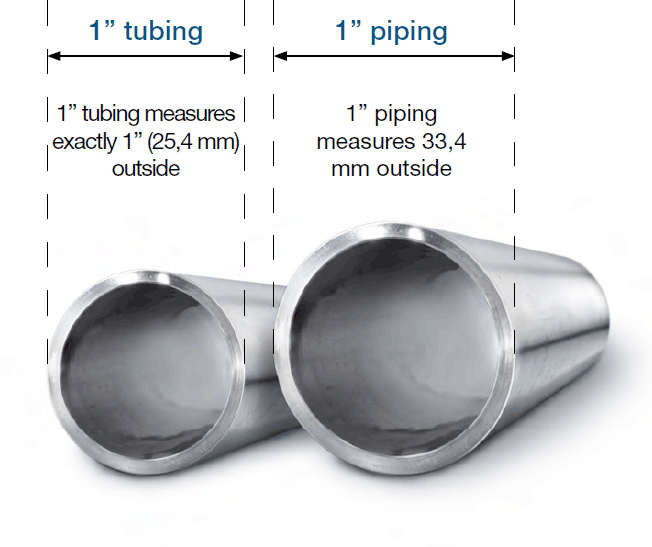
Ask for “a 2-inch pipe” and “a 2-inch tube” and you will get two different products. The pipe will measure 60.3 mm across the outside. The tube will measure 50.8 mm. That single mismatch is behind a surprising number of wrong orders on UAE project sites.
The short answer: pipe is sized by what flows through it; tube is sized by its exact outside dimension. Pipe is built to carry fluids and gases under pressure. Tube is built where precise dimensions matter, such as heat exchangers, instrumentation lines and structural frames.
Below we break down how the two differ, how each is specified, and which one your project actually needs.
How Pipe Is Sized
Pipe uses Nominal Pipe Size (NPS), also called Nominal Bore (NB) or DN in metric drawings. The nominal number is a name, not a measurement.
- From NPS 1/8 to NPS 12, the real outside diameter is larger than the nominal figure. An NPS 2 pipe has an OD of 60.3 mm (2.375 in).
- From NPS 14 upward, the OD equals the nominal size. An NPS 14 pipe has an OD of 355.6 mm (14 in).
- The OD stays fixed for each NPS. Only the wall changes with the schedule (SCH 10, 40, 80, 160, XS, XXS), so a thicker wall means a smaller bore.
Carbon and alloy steel pipe dimensions follow ASME B36.10M. Stainless steel pipe follows ASME B36.19M. If NPS, NB and OD still feel confusing, our pipe size chart guide walks through every size with examples, and the pipe schedule guide explains how wall thickness changes pressure capacity.
How Tube Is Sized
Tube is ordered by its actual outside diameter and actual wall thickness. A 1/2-inch tube measures exactly 12.7 mm OD. The wall is given in millimetres, inches or a gauge (BWG/SWG).
Tube tolerances are also tighter. That is why tube is chosen where a part must slide into a fitting, a tube sheet or a compression ferrule with no play.
Pipe vs Tube at a Glance
| Feature | Pipe | Tube |
| How it is named | Nominal size (NPS / NB / DN) + schedule | Actual OD + actual wall thickness |
| What the size tells you | Approximate flow capacity | Exact outside dimension |
| Main job | Carry fluids and gases under pressure | Heat transfer, instrumentation, mechanical and structural use |
| Dimensional tolerance | Standard | Tighter |
| Typical shapes | Round only | Round, square, rectangular, oval |
| Typical joining | Butt welding, socket welding, threading, flanges | Compression fittings, expansion into tube sheets, orbital welding |
| Common standards | ASTM A106, A53, API 5L, ASTM A312, A333, A335 | ASTM A179, A192, A213, A269, A249, A500, A513 |
| Typical lengths | Single random (about 6 m) or double random (about 12 m) | Often cut to exact length |
Same Number, Different Size: A Quick Comparison
| Size called out | Pipe OD (NPS) | Tube OD |
| 1/2 inch | 21.3 mm | 12.7 mm |
| 1 inch | 33.4 mm | 25.4 mm |
| 2 inch | 60.3 mm | 50.8 mm |
| 4 inch | 114.3 mm | 101.6 mm |
| 14 inch | 355.6 mm | 355.6 mm |
The gap closes at 14 inches and above, which is exactly why large-bore buyers rarely hit this problem and small-bore buyers hit it all the time.
Where Pipe Is Used in UAE Projects
Pipe is the backbone of anything that moves product under pressure:
- Oil and gas: flowlines, process piping and transmission lines, usually ASTM A106 Grade B or API 5L line pipe.
- Petrochemical and refining: high-temperature lines in alloy steel (ASTM A335 P11, P22, P91) and corrosive service in stainless steel (ASTM A312 TP316L).
- Low-temperature service: LNG and cold process lines in ASTM A333 Grade 6.
- Utilities and desalination: cooling water, firewater and seawater systems, often in duplex or lined carbon steel.
Pipe connects to the rest of the system through buttweld and forged pipe fittings and flanges, all of which are made to the same nominal sizes.
Where Tube Is Used
- Heat exchangers and condensers: ASTM A179 carbon steel and ASTM A213 or A249 stainless tubes, expanded into tube sheets.
- Boilers and superheaters: ASTM A192 and A213 alloy tubes rated for high temperature.
- Instrumentation and hydraulics: seamless 316/316L tubing to ASTM A269 with compression fittings, typically 1/4, 3/8 and 1/2 inch.
- Structures and machinery: square and rectangular hollow sections to ASTM A500, and ERW mechanical tubing to ASTM A513.
Which One Does Your Project Need?
Work through these three questions:
- Is the line carrying fluid or gas under pressure? If yes, you almost certainly need pipe, specified by NPS and schedule.
- Must the part fit an exact dimension such as a tube sheet, ferrule or machine component? Then you need tube, specified by OD and wall.
- What does the drawing actually say? Check whether the line list shows NPS/schedule or OD/wall. Our guide on how to read steel pipe specifications shows where to look.
When the drawing is unclear, ask before you order. A quick check costs minutes. A wrong delivery on a shutdown costs days.
Common Ordering Mistakes (and How to Avoid Them)
- Ordering “2-inch” without saying pipe or tube. Always state NPS + schedule for pipe, or OD × wall for tube.
- Mixing B36.10M and B36.19M wall thicknesses. Stainless SCH 10S and 40S are not always identical to carbon steel SCH 10 and 40.
- Forgetting the end finish. Plain end, bevelled end and threaded end are separate line items.
- Ignoring documents. Ask for EN 10204 3.1 mill test certificates that match the heat number on the pipe.
Sourcing Pipes in the UAE
JSS Pipes is a steel pipe supplier in the UAE holding seamless and welded carbon steel, low-temperature and stainless steel pipe for oil and gas, EPC and industrial projects. Our technical team checks the size, schedule, grade and documents on your material list before quoting, so pipe and tube never get mixed up.
You can download our pipe schedule charts and material cross-reference guide from the Resources page, or send us your material list for a quotation.
FAQs
Is a pipe stronger than a tube? Not automatically. Strength depends on the material grade and wall thickness. Pipe is designed and tested for internal pressure; tube is made to tighter dimensional tolerances.
Why is a 2-inch pipe not 2 inches wide? Nominal sizes date back to early iron pipe, when the number roughly matched the bore. The OD was fixed so fittings stayed compatible as walls got thinner. For NPS 1/8 to 12, the name and the OD no longer match.
Can I use tube instead of pipe? Only if the design code and the engineer approve it. Tube and pipe use different standards, sizes and fittings, so they are not interchangeable by default.
What is the difference between seamless and welded pipe? Seamless pipe has no weld seam and is often preferred for high pressure. Welded pipe is formed from plate or strip and is economical in larger diameters. See our seamless vs welded pipe comparison.What does NB mean in pipe sizing? NB stands for Nominal Bore. It is the same idea as NPS, used mainly in India, the UK and the Middle East.