Understanding Pipe Schedules and Choosing the Right One for Industrial Applications
Selecting the correct pipe size is essential for designing safe, efficient, and cost-effective industrial piping systems. Whether you’re working in the oil & gas, petrochemical, construction, power generation, or water treatment industry, understanding pipe dimensions helps ensure compatibility between pipes, fittings, valves, and flanges.
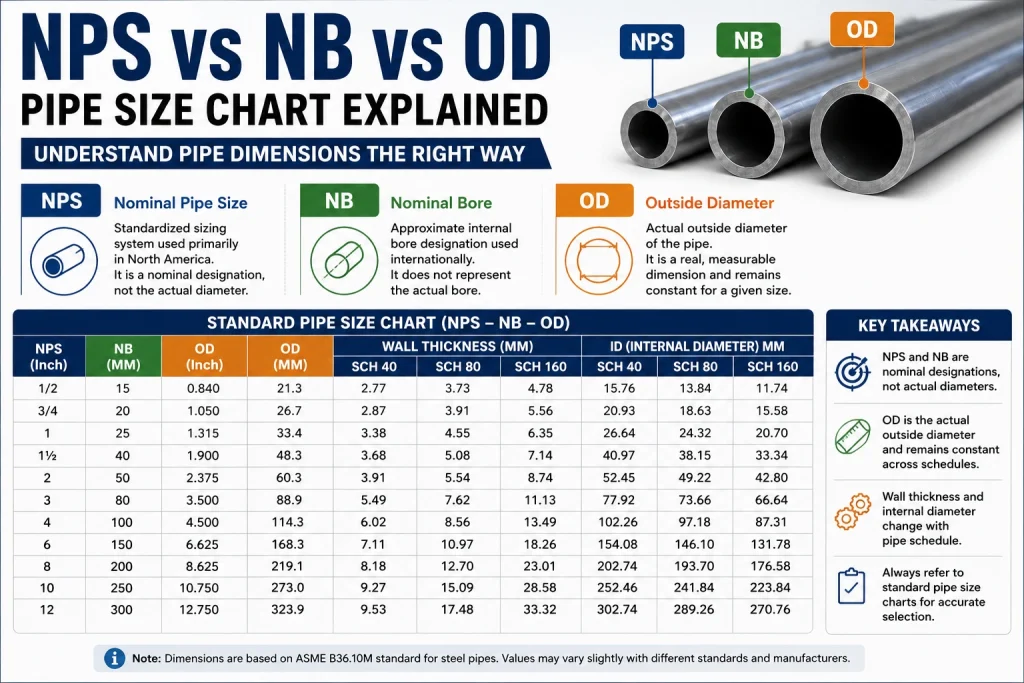
One of the most common areas of confusion is the difference between NPS (Nominal Pipe Size), NB (Nominal Bore), and OD (Outside Diameter). Although these terms are closely related, they do not represent the same measurement. Misunderstanding them can lead to incorrect material selection, installation issues, and costly project delays.
This guide explains how to read a pipe size chart, the differences between NPS, NB, and OD, and why these measurements are critical for industrial piping applications.
What Is a Pipe Size Chart?
A pipe size chart is a standardized reference used to identify the dimensions of industrial pipes. Instead of relying on actual inside or outside diameters alone, pipe sizing follows internationally recognized standards that make it easier to manufacture, specify, and install piping components.
A typical pipe size chart includes:
- Nominal Pipe Size (NPS)
- Nominal Bore (NB)
- Outside Diameter (OD)
- Pipe Schedule
- Wall Thickness
- Internal Diameter (depending on schedule)
Using standardized pipe sizes ensures that pipes, fittings, valves, and flanges from different manufacturers remain compatible with one another.
What Is NPS (Nominal Pipe Size)?
Nominal Pipe Size (NPS) is the standard pipe sizing system used primarily in North America.
Although the term contains the word size, NPS is not the actual outside or inside diameter of the pipe. Instead, it is a nominal designation used to identify pipes according to standardized dimensions.
For smaller pipe sizes (up to NPS 12), the NPS number does not exactly match either the internal or external diameter. For larger sizes (above NPS 14), the NPS value generally corresponds more closely to the actual outside diameter measured in inches.
Because of this standardization, engineers can specify compatible fittings and flanges without calculating dimensions for every project.
What Is NB (Nominal Bore)?
Nominal Bore (NB) is another standardized method of identifying pipe sizes and is commonly used in many international markets, including the Middle East, Europe, Asia, and Australia.
Unlike the actual bore of a pipe, NB is only an approximate reference and does not represent the exact internal diameter.
For example:
- 1″ pipe = 25 NB
- 2″ pipe = 50 NB
- 4″ pipe = 100 NB
This sizing system allows engineers and procurement teams across different regions to specify pipe sizes using a consistent terminology.
Although the names differ, NPS and NB generally refer to equivalent nominal pipe sizes, making conversion straightforward during international projects.
What Is OD (Outside Diameter)?
Outside Diameter (OD) refers to the actual external diameter of a pipe and is one of the most important physical dimensions in industrial piping.
Unlike NPS and NB, OD is an actual measurable dimension expressed in inches or millimetres.
The outside diameter remains constant for a given nominal pipe size, regardless of the pipe schedule.
For example:
A 4-inch NPS pipe always has an outside diameter of approximately 4.500 inches (114.3 mm), whether it is SCH 40, SCH 80, or SCH 160.
Only the wall thickness changes with different schedules.
This standardization allows fittings, flanges, couplings, and branch connections to fit correctly across multiple schedules.
NPS vs NB vs OD: Key Differences
Although these three terms are often used together, they describe different aspects of pipe sizing.
Feature | NPS | NB | OD |
Full Form | Nominal Pipe Size | Nominal Bore | Outside Diameter |
Measurement Type | Nominal | Nominal | Actual |
Represents | Standard Pipe Size | Approximate Bore | Physical Outside Diameter |
Unit | Inches | Millimetres | Inches / mm |
Changes With Pipe Schedule | No | No | No |
Used For | Pipe Identification | International Pipe Identification | Manufacturing & Fitting Compatibility |
The key takeaway is that NPS and NB are naming systems, while OD is the actual physical measurement of the pipe.
How to Read a Pipe Size Chart
Reading a pipe size chart becomes much easier once you understand how each column relates to the pipe.
A standard industrial pipe size chart usually contains:
Nominal Pipe Size (NPS)
The standardized size designation used in engineering drawings and specifications.
Nominal Bore (NB)
The international equivalent of the NPS designation, generally expressed in millimetres.
Outside Diameter (OD)
The actual outside diameter of the pipe.
Pipe Schedule
The wall thickness classification of the pipe, such as SCH 40, SCH 80, or SCH 160.
Internal Diameter (ID)
The actual inside diameter changes depending on the selected pipe schedule because thicker walls reduce the internal flow area.
Understanding these values helps engineers select compatible piping components while ensuring proper flow capacity and pressure performance.
Common Pipe Size Chart
The table below shows several commonly used industrial pipe sizes.
NPS | NB | Outside Diameter (Inches) | Outside Diameter (mm) |
½ | 15 | 0.840 | 21.3 |
¾ | 20 | 1.050 | 26.7 |
1 | 25 | 1.315 | 33.4 |
1½ | 40 | 1.900 | 48.3 |
2 | 50 | 2.375 | 60.3 |
3 | 80 | 3.500 | 88.9 |
4 | 100 | 4.500 | 114.3 |
6 | 150 | 6.625 | 168.3 |
8 | 200 | 8.625 | 219.1 |
10 | 250 | 10.750 | 273.0 |
12 | 300 | 12.750 | 323.9 |
Note: The outside diameter remains constant for a given NPS. Only the wall thickness and internal diameter change when a different pipe schedule is selected.
Why Understanding Pipe Dimensions Is Important
Selecting the correct pipe size is about more than simply matching diameters. Every industrial piping system is designed to operate within specific flow rates, pressure limits, and temperature conditions. Understanding pipe dimensions helps ensure that all components fit together correctly while maintaining safe and efficient system performance.
Accurate knowledge of NPS, NB, and OD helps engineers and buyers:
- Select compatible pipes and fittings
- Match valves and flanges correctly
- Maintain proper flow capacity
- Avoid installation errors
- Reduce pressure losses
- Ensure compliance with international piping standards
Even a small misunderstanding in pipe sizing can lead to fabrication delays, leakage issues, or costly modifications during installation.
How Engineers Select the Correct Pipe Size
Choosing the right pipe size involves evaluating several technical factors rather than relying only on the nominal designation.
Flow Rate
The required flow rate determines the pipe diameter needed to transport liquids or gases efficiently without excessive pressure loss.
Higher flow rates generally require larger pipe sizes to maintain optimal velocity.
Operating Pressure
Pressure influences both the pipe schedule and the overall pipe selection. High-pressure systems often require thicker pipe walls while maintaining the same outside diameter.
Fluid Characteristics
Engineers also consider the properties of the fluid, including:
- Viscosity
- Density
- Corrosiveness
- Temperature
- Flow velocity
These factors affect both pipe size and material selection.
Available Installation Space
Space limitations may influence routing and pipe diameter, particularly in industrial plants where multiple services share the same pipe racks.
Industry Standards
Pipe dimensions should always comply with internationally recognized standards such as:
- ASME
- ASTM
- API
- ANSI
Using standardized dimensions ensures compatibility across different manufacturers and project specifications.
NPS vs DN: Are They the Same?
Another common source of confusion is the difference between NPS and DN (Diameter Nominal).
Although both identify nominal pipe sizes, they use different measurement systems.
NPS | DN |
Inch-based designation | Metric designation |
Used primarily in North America | Used internationally |
Example: NPS 2 | DN 50 |
Example: NPS 4 | DN 100 |
Example: NPS 6 | DN 150 |
While the numbers differ, they generally represent equivalent nominal pipe sizes, making international engineering projects easier to standardize.
Common Pipe Sizes Used Across Industries
Different industries typically rely on specific pipe sizes depending on the application.
Oil & Gas
Large-diameter pipes are commonly used for transporting crude oil, natural gas, and refined products over long distances.
Petrochemical Plants
Medium and large pipe sizes handle process fluids, steam, and chemical transportation within production facilities.
Water Treatment
Water distribution systems often use a combination of small, medium, and large pipe sizes depending on flow requirements.
Power Generation
Power plants use multiple pipe sizes for steam lines, cooling systems, condensate return, and auxiliary services.
Manufacturing Facilities
Factories typically require a mix of pipe dimensions for compressed air, cooling water, process fluids, and utility systems.
Selecting the appropriate dimensions from a standard pipe size chart helps improve system efficiency while ensuring compatibility with valves, fittings, and flanges.
Common Mistakes When Reading Pipe Sizes
Understanding pipe terminology helps avoid expensive specification errors.
Confusing NPS with OD
Many assume that a 4-inch NPS pipe has an outside diameter of exactly 4 inches. In reality, a 4-inch NPS pipe has an outside diameter of 4.500 inches (114.3 mm).
Assuming NB Is the Actual Internal Diameter
NB is only a nominal designation and should not be confused with the pipe’s actual bore.
Ignoring Pipe Schedule
The internal diameter changes when the schedule changes, even though the outside diameter remains constant.
Using Actual Measurements Instead of Standard Sizes
Industrial piping should always be specified using standardized NPS or NB designations rather than measured diameters.
Ignoring Engineering Standards
Always verify pipe dimensions against recognized standards before procurement or installation.
Best Practices for Selecting Pipe Sizes
Following industry best practices helps improve piping system performance and reduce long-term maintenance.
Recommended practices include:
- Refer to standard pipe size charts during design.
- Verify NPS, NB, and OD before ordering materials.
- Confirm pipe schedule based on pressure requirements.
- Ensure compatibility between pipes, fittings, valves, and flanges.
- Follow ASME, ASTM, API, and ANSI standards.
- Review manufacturer specifications before procurement.
Proper planning reduces installation issues and improves the reliability of industrial piping systems.
Conclusion
Understanding the relationship between NPS, NB, and OD is essential for designing, specifying, and maintaining industrial piping systems. While NPS and NB are nominal sizing systems used for identification, OD represents the actual outside diameter that ensures compatibility with fittings, flanges, and valves.
Using a standard pipe size chart helps engineers, contractors, and procurement teams select the correct piping components while reducing installation errors and improving overall system performance. By combining the correct pipe size with the appropriate schedule and material, industrial projects can achieve greater efficiency, safety, and long-term reliability.
Frequently Asked Questions
Q1. What is NPS in piping?
Ans – NPS (Nominal Pipe Size) is a standardized sizing system used primarily in North America to identify pipe dimensions. It is a nominal designation rather than the actual measured diameter.
Q2. What is the difference between NPS and NB?
Ans – NPS is an inch-based nominal pipe sizing system, while NB (Nominal Bore) is the metric equivalent commonly used in many international markets. They generally refer to the same standard pipe size.
Q3. Does pipe schedule change the outside diameter?
Ans – No. Changing the pipe schedule increases or decreases the wall thickness, but the outside diameter remains the same for a given nominal pipe size.
Q4. Is NB equal to the internal diameter?
Ans – No. NB is only a nominal designation and does not represent the pipe’s exact internal diameter.
Q5. Why is the outside diameter different from the NPS?
Ans – NPS is a standardized naming convention, whereas OD is the actual physical measurement of the pipe. For example, an NPS 4 pipe has an OD of 4.500 inches.
Q6. How do I read a pipe size chart?
Ans – Read the chart by identifying the NPS or NB, then refer to the corresponding outside diameter, wall thickness (schedule), and other dimensional information required for your application.
Q7. What is the most commonly used pipe size?
Ans – Common industrial pipe sizes include NPS 1, NPS 2, NPS 4, NPS 6, and NPS 8, although the correct size depends on the system’s flow and pressure requirements.
Q8. Are NPS and DN the same?
Ans – They are different designation systems but generally represent equivalent nominal pipe sizes. For example, NPS 2 corresponds approximately to DN 50.
Q9. How do engineers select the correct pipe size?
Ans – Engineers evaluate flow rate, operating pressure, fluid characteristics, temperature, available space, and applicable engineering standards before selecting a pipe size.
Q10. Which standards define pipe dimensions?
Ans – Pipe dimensions are defined by internationally recognized standards such as ASME, ASTM, API, and ANSI, ensuring consistency and compatibility across industrial piping systems.