Understanding the Right Branch Connection for Industrial Piping Systems
Industrial piping systems require reliable branch connections to maintain structural integrity, support fluid flow, and ensure safe operation under varying pressure and temperature conditions. Among the most widely used branch outlet fittings are Weldolets and Sockolets. While both are designed to create branch connections, they differ significantly in their connection method, pressure capabilities, installation process, and ideal applications.
Selecting the wrong branch fitting can lead to increased fabrication costs, unnecessary maintenance, or reduced system efficiency. Understanding the differences between these two fittings helps engineers, contractors, and procurement teams make informed decisions based on project requirements.
In this guide, we’ll compare Weldolet vs Sockolet, explain where each fitting performs best, and help you determine which option is suitable for your industrial piping system.
Weldolet vs Sockolet
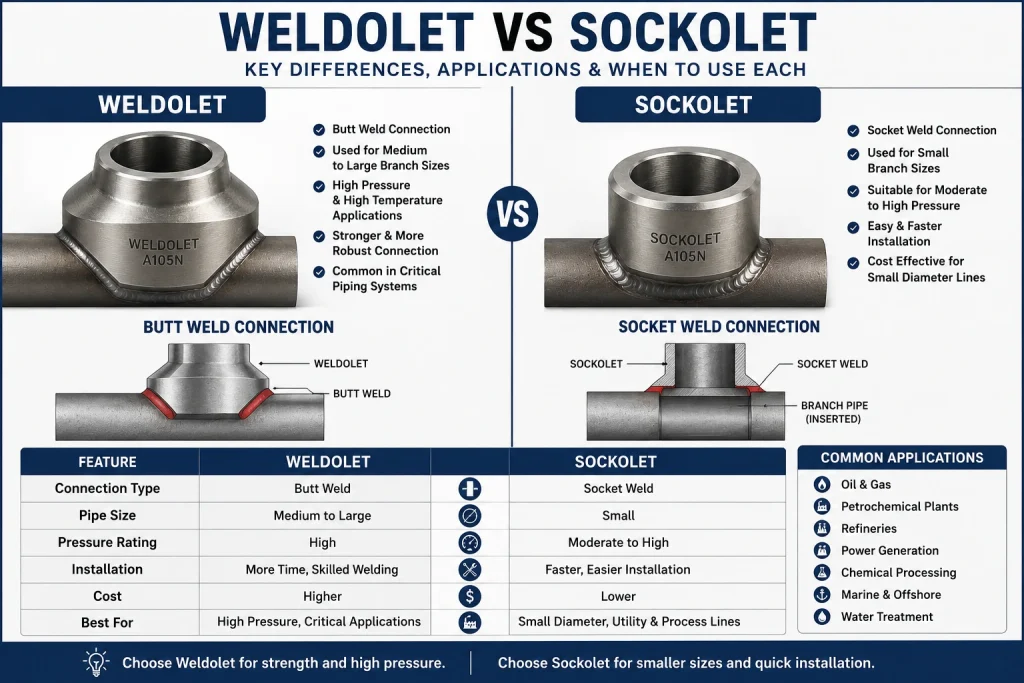
The primary difference between a Weldolet and a Sockolet lies in how they connect to the branch pipe. A Weldolet uses a butt-weld connection, making it ideal for medium to large pipe sizes and high-pressure applications. A Sockolet, on the other hand, uses a socket weld connection and is better suited for smaller branch pipes where easy installation and reliable sealing are important. The right choice depends on pipe size, pressure rating, operating temperature, and the specific industrial application.
What Is a Weldolet?
A Weldolet is a forged branch connection fitting designed to create a 90-degree branch from a larger run pipe using a butt-weld connection. It provides a reinforced outlet that distributes stress more efficiently than a traditional branch connection, making it a preferred choice for high-pressure and high-temperature piping systems.
Unlike reducing tees, a Weldolet requires less material and welding while maintaining excellent structural strength. Its contoured base matches the curvature of the main pipe, creating a smooth and secure connection that improves flow characteristics and minimizes stress concentration.
For industries that require dependable branch connections, sourcing quality fittings from experienced Weldolet Suppliers UAE helps ensure compliance with international piping standards and long-term system reliability.
Common Applications of Weldolets
- Oil & gas pipelines
- Petrochemical plants
- Refineries
- Offshore platforms
- Power generation facilities
- Chemical processing plants
- Industrial utility piping
What Is a Sockolet?
A Sockolet is another type of branch outlet fitting, but instead of using a butt weld, it connects to the branch pipe through a socket weld connection. The branch pipe is inserted into the socket before welding, creating a secure joint that is particularly suitable for smaller pipe sizes.
Sockolets are commonly selected for piping systems where branch connections involve small-diameter pipes and moderate to high operating pressures. Because the branch pipe fits directly into the socket, installation is generally faster and requires less alignment compared to butt-welded connections.
Their compact design also makes them useful in installations where available space is limited.
Common Applications of Sockolets
- Steam distribution systems
- Utility piping
- Instrumentation lines
- Compressed air systems
- Small process pipelines
- Chemical plants
- Power stations
Weldolet vs Sockolet: Key Differences
Although both fittings serve the same purpose of creating branch outlets, they differ in several important ways.
Feature | Weldolet | Sockolet |
Branch Connection | Butt Weld | Socket Weld |
Branch Pipe Size | Medium to Large | Small Diameter |
Installation | Butt Welding | Socket Welding |
Pressure Capability | High | Moderate to High |
Flow Characteristics | Excellent | Very Good |
Fabrication Time | Slightly Longer | Faster |
Typical Industries | Oil & Gas, Petrochemical | Utilities, Process Plants |
Connection Method
The most noticeable difference between these fittings is the welding technique.
A Weldolet requires the branch pipe to be butt welded, creating a continuous welded joint with excellent mechanical strength. This type of connection is commonly specified for systems operating under high pressure or elevated temperatures.
A Sockolet, however, uses a socket weld design. The branch pipe slides into the socket before welding around the outer edge. This approach simplifies installation for smaller pipe sizes and reduces alignment challenges during fabrication.
Pipe Size Compatibility
Choosing between a Weldolet and a Sockolet often depends on the branch pipe size.
Weldolets
Weldolets are generally preferred when connecting medium to large diameter branch pipes. Their design provides sufficient reinforcement to withstand demanding industrial operating conditions.
Sockolets
Sockolets are primarily used for small bore branch connections, making them an excellent solution for instrumentation lines, utility piping, and smaller process systems where compactness and ease of installation are important.
Pressure and Temperature Performance
Industrial piping systems frequently operate under challenging conditions, making pressure and temperature ratings critical factors when selecting branch fittings.
Weldolets perform exceptionally well in high-pressure and high-temperature applications because the butt-welded connection provides maximum structural integrity.
Sockolets also offer reliable performance but are generally selected for small-diameter piping systems operating within the design limits of socket weld connections.
Proper material selection, pressure class, and compliance with industry standards remain essential regardless of the fitting type.
Installation Differences
Installation methods also influence the choice between these fittings.
Installing a Weldolet
The installation process involves preparing the main pipe, accurately positioning the fitting, and completing a full butt weld on the branch connection. Although this requires skilled welding, it results in a highly durable and robust connection.
Installing a Sockolet
Sockolets simplify installation by allowing the branch pipe to be inserted directly into the fitting’s socket before welding. This method reduces alignment complexity and can help shorten fabrication time on projects with multiple small branch connections.
When Should You Use a Weldolet?
A Weldolet is the preferred choice when your piping system requires a strong, permanent, and high-pressure branch connection. Its butt-weld design provides excellent mechanical strength and minimizes stress concentration, making it suitable for critical industrial applications.
Engineers typically specify Weldolets for larger branch sizes where reliability and long-term performance are essential.
A Weldolet is the right choice when:
- The piping system operates under high pressure.
- High operating temperatures are involved.
- The branch pipe is medium or large in diameter.
- Maximum structural integrity is required.
- The system is used in oil & gas, refineries, or petrochemical plants.
- Long-term durability is a priority.
Choosing quality fittings from trusted Weldolet Suppliers UAE helps ensure dimensional accuracy, material consistency, and compliance with recognized industry standards for demanding industrial projects.
When Should You Use a Sockolet?
Sockolets are designed for small-diameter branch connections where installation speed, compactness, and reliable socket weld joints are important.
Because the branch pipe fits directly into the socket before welding, fabrication is generally quicker than butt-welded alternatives for smaller pipe sizes.
Sockolets are commonly selected for:
- Instrument air lines
- Utility piping
- Steam tracing systems
- Small process pipelines
- Water distribution systems
- Compressed air systems
Their compact design also makes them suitable for installations where available space is limited.
Industries That Commonly Use Weldolets and Sockolets
Although these fittings differ in design, both are widely used across industries that require safe and efficient branch connections.
Oil & Gas
From upstream drilling operations to downstream refineries, both fittings help create reliable branch outlets capable of handling demanding operating conditions.
Petrochemical Plants
Petrochemical facilities rely on branch outlet fittings for transporting chemicals, hydrocarbons, and process fluids while maintaining system integrity.
Power Generation
Steam, condensate, cooling water, and process pipelines frequently incorporate Weldolets and Sockolets depending on pipe size and pressure requirements.
Chemical Processing
Chemical plants require corrosion-resistant branch fittings capable of handling aggressive process media under controlled operating conditions.
Many of these applications utilize stainless steel products supplied by experienced SS Fittings Suppliers UAE to improve corrosion resistance and extend service life.
Marine Industry
Shipbuilding and offshore installations use branch outlet fittings in seawater systems, ballast lines, fuel systems, and cooling circuits where durability is essential.
Water Treatment Facilities
Water treatment plants depend on reliable branch fittings to distribute process water, chemicals, and treated water throughout complex piping networks.
How to Choose the Right Branch Connection
Selecting between a Weldolet and a Sockolet requires evaluating several engineering factors rather than simply choosing the lower-cost option.
Consider the following before making your selection:
Pipe Size
Larger branch pipes generally benefit from Weldolets, while smaller branch connections are often better suited to Sockolets.
Operating Pressure
High-pressure systems typically require the additional strength provided by a butt-welded Weldolet connection.
Operating Temperature
Higher temperatures increase stress on welded joints, making proper fitting selection even more important.
Welding Method
Project specifications often determine whether butt weld or socket weld connections should be used.
Maintenance Requirements
Systems requiring frequent inspection or future modifications should be designed with long-term accessibility in mind.
Industry Standards
Always select fittings that comply with applicable ASME, ASTM, and MSS standards to ensure safe and reliable operation.
Working with a trusted Pipe Fittings Supplier UAE can also help ensure the selected fitting matches the project’s technical specifications and application requirements.
Common Mistakes to Avoid
Even experienced procurement teams occasionally make mistakes when selecting branch outlet fittings.
Avoid these common issues:
- Selecting fittings based only on cost
- Ignoring pressure ratings
- Choosing the wrong welding method
- Using incompatible materials
- Overlooking corrosion requirements
- Not verifying applicable industry standards
- Purchasing from unverified suppliers
Proper engineering evaluation helps reduce maintenance costs while improving the overall reliability of the piping system.
Final Verdict: Weldolet vs Sockolet
Neither fitting is universally better than the other—the right choice depends on your application’s technical requirements.
If your project involves high-pressure systems, larger branch sizes, and demanding industrial environments, a Weldolet is generally the preferred solution because of its butt-welded strength and excellent structural performance.
If your system uses small-diameter branch pipes and requires quicker installation with socket weld connections, a Sockolet is often the more practical option.
Understanding these differences allows engineers and procurement teams to select the most efficient fitting while improving safety, reducing fabrication complexity, and extending the lifespan of the piping system.
Conclusion
Weldolets and Sockolets both play an important role in creating reliable branch connections within industrial piping systems. While they may appear similar at first glance, their connection methods, pressure capabilities, installation techniques, and ideal applications are quite different.
Weldolets are best suited for demanding, high-pressure applications involving larger branch connections, whereas Sockolets provide a practical solution for smaller branch pipes where socket weld construction offers installation advantages.
Choosing the appropriate fitting based on pipe size, operating conditions, and applicable standards helps improve system performance while reducing maintenance and long-term operational costs. Partnering with an experienced pipe supplier in UAE also ensures access to high-quality piping components that meet the needs of industrial, EPC, and infrastructure projects.
Frequently Asked Questions
Q1. What is the main difference between a Weldolet and a Sockolet?
Ans – A Weldolet uses a butt-weld connection for medium to large branch pipes, while a Sockolet uses a socket weld connection designed primarily for smaller branch pipes.
Q2. Which fitting is better for high-pressure piping systems?
Ans – Weldolets are generally preferred for high-pressure and high-temperature applications because butt-welded joints provide greater structural strength and reliability.
Q3. When should a Sockolet be used?
Ans – Sockolets are commonly used for small-diameter branch connections in utility piping, instrumentation lines, steam systems, and other moderate-pressure applications.
Q4. Are Weldolets and Sockolets available in different materials?
Ans – Yes. Both fittings are available in carbon steel, stainless steel, alloy steel, and other materials depending on the application’s pressure, temperature, and corrosion requirements.
Q5. Which industries commonly use Weldolets and Sockolets?
Ans – These fittings are widely used in oil & gas, petrochemical, power generation, chemical processing, marine, water treatment, and manufacturing industries.
Q6. How do I choose between a Weldolet and a Sockolet?
Ans – Consider branch pipe size, operating pressure, temperature, welding method, material compatibility, and applicable industry standards before selecting a fitting.
Q7. Can both fittings comply with international standards?
Ans – Yes. High-quality Weldolets and Sockolets are manufactured in accordance with recognized standards such as ASME, ASTM, and MSS to ensure safe and reliable performance.
Q8. Do Weldolets and Sockolets require different welding techniques?
Ans – Yes. Weldolets use butt welding, whereas Sockolets are installed using socket welding, making each suitable for different piping configurations.
Q9. Which fitting offers easier installation?
Ans – Sockolets generally offer quicker installation for smaller pipe sizes because the branch pipe fits directly into the socket before welding.
Q10. Why is choosing the correct branch fitting important?
Ans – Selecting the right branch fitting improves piping system safety, reduces stress on welded joints, minimizes maintenance, and helps ensure long-term operational reliability.